


Selecting the right mixing equipment for your bulk solids processing line is one of the most consequential decisions you will make. The wrong choice can lead to inconsistent product quality, extended cycle times, excessive maintenance, and lost profitability.
Among the most common options for dry powder and granular materials, the horizontal ribbon blender stands out as the workhorse of the industry — but it is not the ideal solution for every application. The most frequent question we hear from customers is: "Should I choose a ribbon blender or a tumble blender?"
This guide provides a direct, practical comparison to help you make the right decision based on your specific material characteristics and production goals.
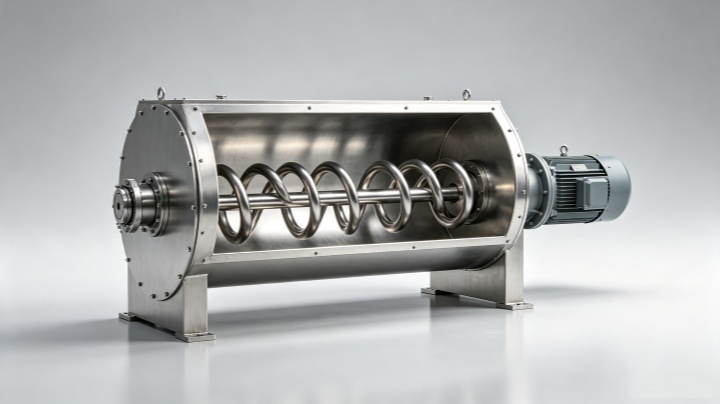
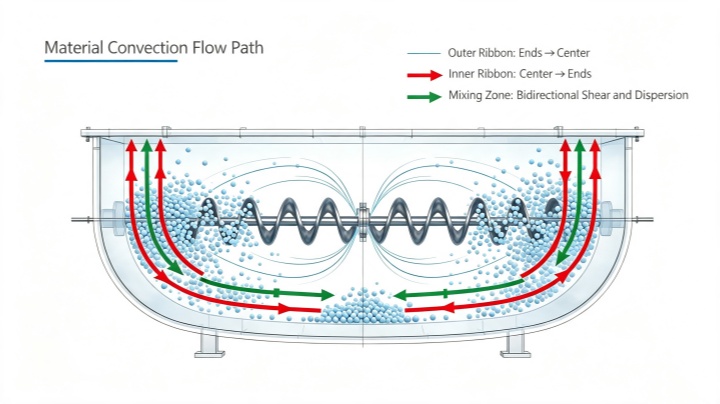
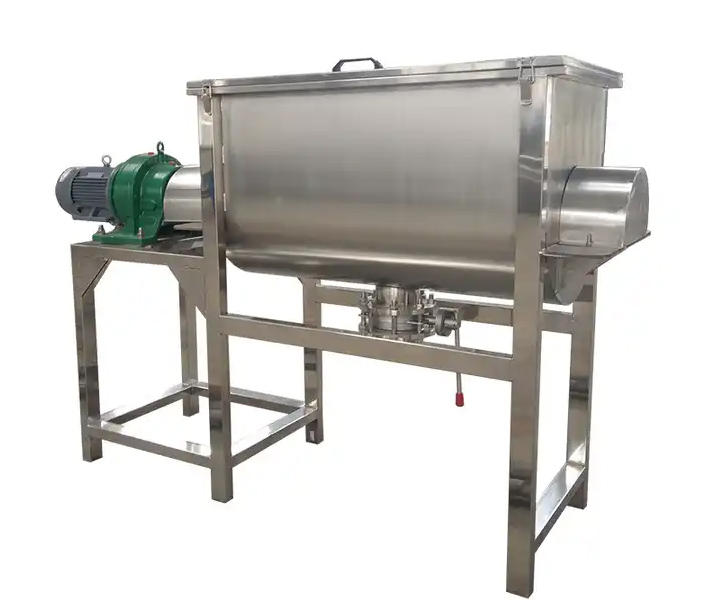
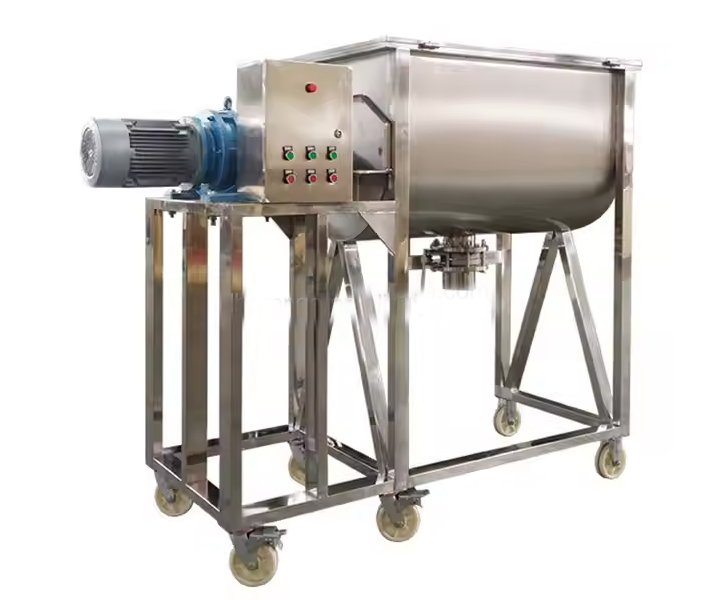
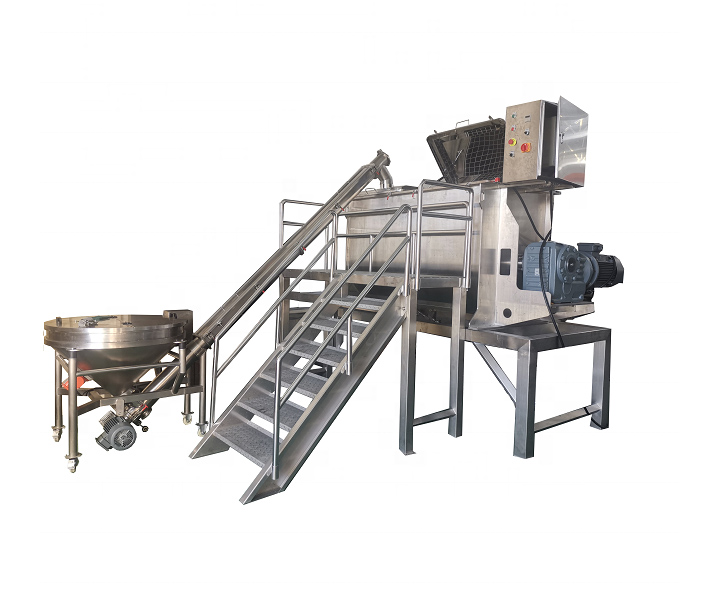
A horizontal ribbon blender consists of a U‑shaped trough and a double‑layer ribbon agitator mounted on a central shaft. The inner and outer helical ribbons rotate in opposite directions: the outer ribbon moves material from the ends toward the center, while the inner ribbon pushes material outward toward the trough wall. This counter‑current flow pattern creates both radial and axial movement, achieving mixing uniformity exceeding 99% in just 5 to 15 minutes.
Key strengths of the ribbon blender:
High throughput — loading capacity up to 70% of total volume, approximately 20% higher than ordinary mixers
Fast cycle times — typically 5–10 minutes per batch, significantly boosting production efficiency
Versatility — handles powders, granules, flakes, and semi‑wet materials across food, pharmaceutical, chemical, and building materials industries
Cost‑effectiveness — lower initial capital cost compared to tumble blenders
Scalability — available from lab‑scale (100L) to large production units (up to 30,000L)
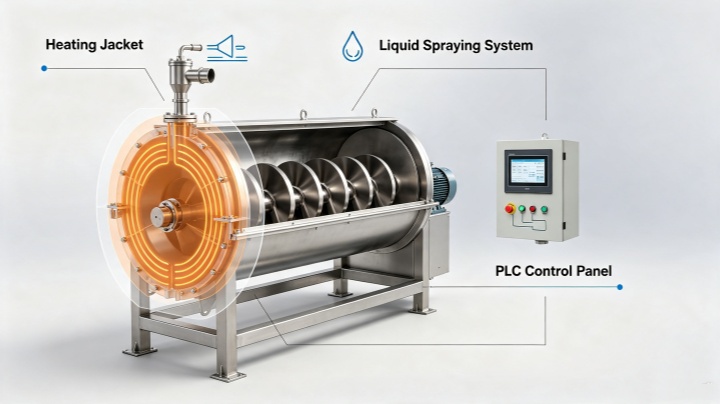
Customizable — options for heating/cooling jackets, spray bars, PLC automation, and various discharge valves
Limitations to consider:
Ribbon blenders are not suitable for highly sticky materials, very dense powders, or highly friable (fragile) ingredients that may degrade under mechanical agitation. The minimum fill level requirement is approximately 30% — below this, the ribbons cannot create effective circulation.
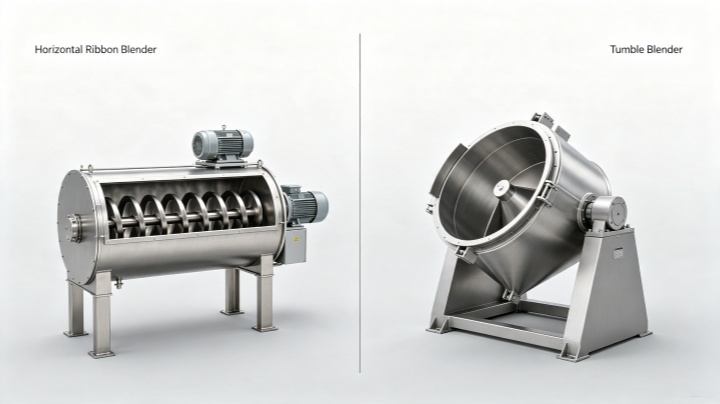
Tumble blenders — including V‑blenders and double‑cone designs — use a rotating vessel to gently fold powders over themselves through gravity‑driven tumbling. This low‑impact action makes them the standard choice for applications where particle integrity is paramount. However, this gentle action comes with trade‑offs in throughput, cost, and versatility.
The ribbon blender uses mechanical agitation to actively move material. The rotating ribbons create a three‑dimensional flow pattern that forces material to circulate throughout the trough. This active mixing is what makes the ribbon blender so fast and effective.
The tumble blender, by contrast, relies entirely on gravity. As the vessel rotates, material is lifted and then falls back into the batch. This passive mixing is gentle but slow, and it relies heavily on the initial loading pattern for effectiveness.
Mixing Efficiency and Cycle Time
The ribbon blender achieves uniform mixing in 5 to 15 minutes, regardless of batch size. The mechanical action ensures that every particle is actively moved and mixed. For a typical 1,000L batch, a ribbon blender can complete the mixing cycle in under 10 minutes.
The tumble blender typically requires 20 to 60 minutes for the same batch. The passive tumbling action is inherently slower, and cycle times increase with batch size. For large production volumes, this difference in cycle time directly impacts throughput and labor costs.
Batch Size and Throughput
Ribbon blenders are available in sizes from 100L to 30,000L, with loading capacity reaching 70% of total volume. A 1,000L ribbon blender can process 400–600L of material per batch. The large opening and easy loading make them ideal for high‑volume production lines.
Tumble blenders are generally limited to smaller batch sizes, typically up to 2,000L. The loading capacity is also lower — usually 50–60% of total volume. For large‑scale production, multiple tumble blenders may be required to match the throughput of a single ribbon blender.
Cost Considerations
The capital cost of a ribbon blender is significantly lower than a tumble blender of equivalent capacity. The simpler construction — a stationary trough with a shaft‑mounted agitator — is less expensive to manufacture than a rotating vessel with complex drive and sealing systems.
Maintenance costs are also lower for ribbon blenders. The drive system is straightforward, and the ribbon agitator is robust and durable. Tumble blenders require more complex drive systems and precision alignment, which increases maintenance requirements and downtime.
Particle Integrity and Attrition
This is the one area where tumble blenders clearly outperform ribbon blenders. If your material is highly friable — meaning it breaks, fractures, or degrades under mechanical stress — the tumble blender is the safer choice.
The ribbon blender's mechanical agitation does create some shear. For most dry powders and granules, this is not an issue. However, for materials like fragile pharmaceutical crystals, ceramic powders, or abrasive minerals, the gentler tumbling action may be worth the trade‑offs in cycle time and cost.
Segregation Risk During Discharge
One of the most overlooked factors in mixer selection is segregation — the tendency of dissimilar materials to separate after mixing. This is a significant problem with tumble blenders. Because the material is only mixed by gravity, particles of different sizes or densities can separate during discharge.
The ribbon blender has a distinct advantage here. The mechanical mixing action creates a more homogeneous blend, and the discharge process is controlled. The ribbon blender's design minimizes the risk of segregation, ensuring consistent product quality from the first batch to the last.
Versatility Across Applications
Ribbon blenders handle a remarkably wide range of materials. Dry powders, granules, flakes, fibers, and even semi‑wet materials — the ribbon blender adapts to all of these. With optional features like spray bars for liquid addition, heating/cooling jackets for temperature‑sensitive materials, and vacuum designs for drying, the ribbon blender becomes a truly multi‑purpose machine.
Tumble blenders are limited to dry, free‑flowing powders. They cannot handle wet materials, nor can they incorporate liquid additions effectively. This limited versatility makes the tumble blender a more specialized piece of equipment.
Cleaning and Changeover
Both types require cleaning between batches, especially in food and pharmaceutical applications. Ribbon blenders feature a U‑shaped trough with smooth internal surfaces that are relatively easy to access. Optional fast‑open lids and inspection ports facilitate cleaning and inspection.
Tumble blenders have smooth interior surfaces that are also easy to clean. However, the rotating vessel design can make access more challenging, and the discharge valve area requires particular attention.
Choose a horizontal ribbon blender when your priorities are:
High throughput — You need to process large volumes quickly
Cost efficiency — You want the best value for your capital investment
Fast cycle times — You need to minimize production time per batch
Versatility — You process different materials or need the flexibility for future product lines
Segregation prevention — Your blend includes components with different particle sizes or densities
Scalability — You need to move from R&D to production with consistent results
Choose a tumble blender when:
Particle integrity is critical — Your material is highly friable and cannot tolerate any mechanical stress
Batch sizes are small — You are processing high‑value materials in small quantities
Purity is the highest priority — You need to eliminate any potential contamination risk from seals or moving parts
The budget allows — You have the capital for the higher upfront cost
For the vast majority of bulk solids mixing applications, the horizontal ribbon blender is the superior choice. It delivers faster cycle times, higher throughput, lower costs, and greater versatility than the tumble blender. The only scenario where the tumble blender wins is when particle fragility is the overriding concern.
This is why ribbon blenders are found in virtually every industry that processes dry powders and granules — from food seasoning plants to pharmaceutical manufacturing, from chemical processing to building materials production. The combination of efficiency, reliability, and value is unmatched.
When evaluating your mixing equipment needs, consider these practical steps:
Step 1: Assess Your Material
Test your material for friability. If it breaks easily under moderate mechanical action, the tumble blender may be necessary. If not, the ribbon blender is the better choice.
Step 2: Calculate Your Throughput Requirements
Determine the volume you need to process per shift. If you need high throughput, the ribbon blender's faster cycle time and larger capacity give it a clear advantage.
Step 3: Evaluate Your Budget
Consider both capital cost and operating cost. The ribbon blender offers better value in both areas, freeing up budget for other production needs.
Step 4: Plan for the Future
Consider what materials you might process in the future. The ribbon blender's versatility makes it a better long‑term investment.
The horizontal ribbon blender is the industry standard for bulk solids mixing for good reason. It offers a combination of performance, reliability, and value that no other mixer type can match. While tumble blenders have their place for fragile materials and small batches, the ribbon blender is the clear choice for high‑volume, cost‑effective production.
Whether you are blending spices, pharmaceuticals, chemicals, or building materials, the horizontal ribbon blender delivers consistent, uniform results batch after batch. Its proven design, customizable options, and ease of maintenance make it the most practical choice for production lines around the world.


Address:China,Yanjin county forest park gate to the west 1000 meters north road.


 Online Chat
 Email
Email