


Choosing the right mixing equipment is a critical decision that directly impacts product quality, production efficiency, and operational costs. For food additive manufacturers, where precision and consistency are paramount, the ribbon blender has become a standard solution. However, not all ribbon blenders are created equal. This guide provides a practical framework to help you evaluate and select the ideal ribbon blender for your specific food additive production needs.
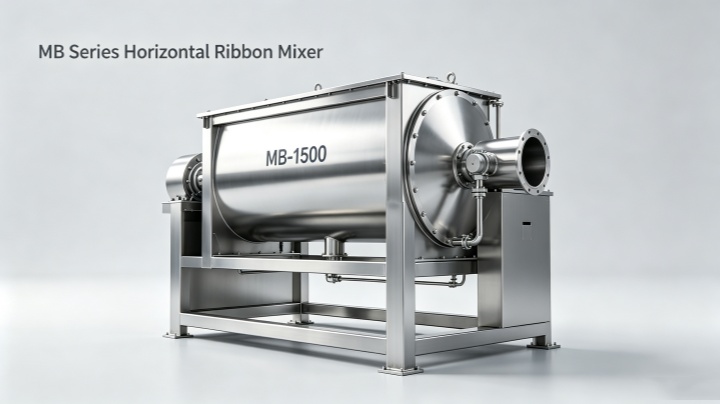
The quality of your final blend depends heavily on the machine that produced it. Under‑mixing leads to inconsistent dosing and "hot spots" of active ingredients; over‑mixing can cause particle segregation or damage fragile components; and the wrong agitator design can leave dead zones where material never circulates.
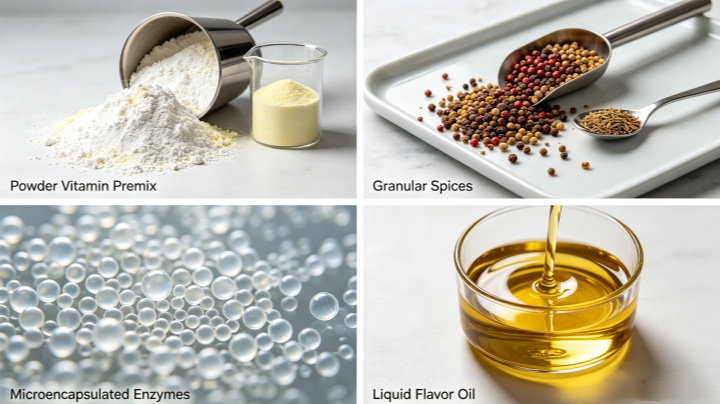
For food additives—which often include trace ingredients like enzymes, vitamins, and flavorings at ratios as low as 1:10,000—even minor mixing inconsistencies can compromise product safety and regulatory compliance. This is why selection should be driven by your specific application requirements, not just horsepower or price tag.
Understand Your Material Characteristics
Before evaluating any equipment, you must thoroughly understand your material profile. This is the most critical step in the selection process.
Bulk Density: This determines the required motor power and whether you need a standard or heavy‑duty model. Most standard ribbon blenders handle bulk densities up to approximately 35 lb/cu ft; higher densities require more robust construction.
Particle Size Distribution: Blending ingredients with similar particle sizes is generally straightforward. However, when you mix materials with significant differences in particle size, shape, or density, the risk of segregation increases. In such cases, the double‑ribbon counter‑current action becomes essential to ensure uniformity.
Flow Characteristics: A ribbon blender performs best when the product flows freely enough to circulate through the inner and outer ribbons. If your formulation tends to bridge, pack, smear, or form lumps, you may need modified ribbon geometry, choppers, or a different mixer design entirely.
Evaluate Mixing Uniformity Requirements
Food additive applications often demand exceptional homogeneity.
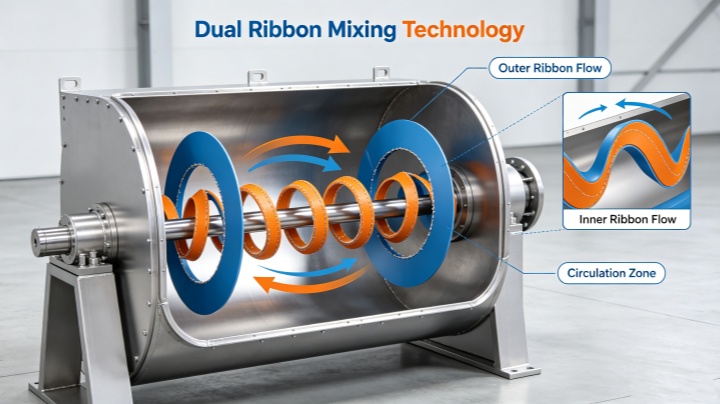
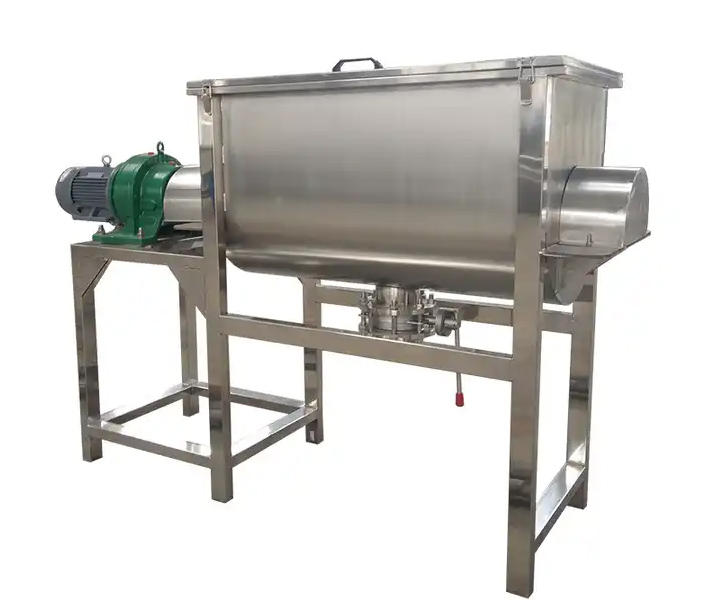
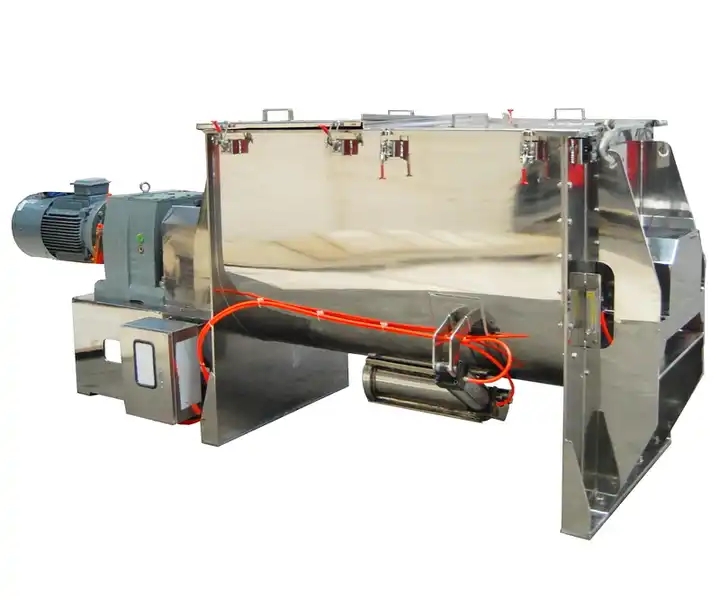
The double‑ribbon design creates a powerful counter‑current mixing action: the outer ribbon moves material in one direction while the inner ribbon pushes it the opposite way. This generates both radial movement (tumbling material toward and away from the shaft) and axial movement (traveling along the trough), achieving thorough distribution in a short time.
For standard dry powder blends, a typical ribbon blender reaches uniformity in 10 to 20 minutes. For food additives requiring even higher precision, modern double‑ribbon blenders can achieve mixing accuracy as high as 1:10,000. This is particularly important for nutritional premixes where vitamin and mineral dosage accuracy is critical.
Consider Liquid Addition Capabilities
Many food additive formulations require adding oils, flavorings, stabilizers, or other liquids during the blending process.
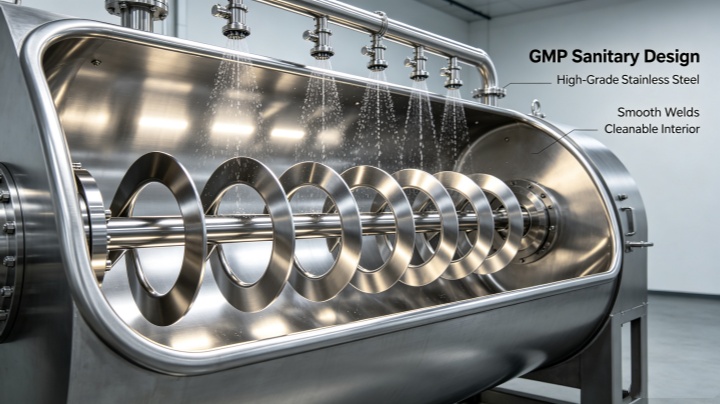
When evaluating equipment, look for ribbon blenders equipped with spray nozzle systems that allow precise liquid injection during mixing. This ensures even distribution and prevents lump formation.
However, there is a practical limit to how much liquid can be added before the product shifts from free‑flowing to sticky and starts coating the ribbons or vessel walls. This threshold varies by formulation and should be tested with your specific materials.
Assess Sanitary Design and Cleanability
For food additive production, hygiene is non‑negotiable. Your equipment must meet GMP and food safety standards.
Key sanitary design features to look for include:
Material of Construction: Stainless steel is standard. SS304 is economical for general food applications, while SS316L offers superior corrosion resistance for acidic or highly corrosive additives. For pharmaceutical‑grade applications, mirror‑polished surfaces (Ra ≤ 0.8μm) are often required.
Surface Finish: Polished interior surfaces prevent bacterial growth and facilitate cleaning. High‑quality ribbon blenders feature well‑polished stainless steel surfaces with radiused welds to eliminate material buildup points.
Clean‑in‑Place (CIP) Systems: For operations requiring frequent recipe changes, CIP systems allow automated cleaning without disassembly, minimizing downtime and ensuring batch‑to‑batch integrity.
Determine Capacity and Throughput Requirements
Capacity selection involves more than choosing the largest vessel possible.
Working Volume vs. Total Volume: Ribbon blenders are typically designed to operate within a defined fill range—generally 60‑75% of rated volumetric capacity, with a minimum of 30‑40% for effective mixing. Overfilling reduces circulation efficiency; underfilling prevents proper contact between agitator and product.
Total Cycle Time: In real production, total cycle time includes loading, blending, liquid addition, sampling, discharge, and cleaning. A blender that mixes in eight minutes but takes twenty minutes to empty or clean becomes a bottleneck. Evaluate the full operating cycle before making a decision.
Future Growth: While it's important to meet current production demands, consider your growth projections. Oversizing too aggressively can reduce performance on smaller batch runs, while a machine sized only for today's demand may require an earlier upgrade than expected.
Evaluate Agitator Design Options
The standard double‑ribbon agitator works well for most food additive applications, but variations exist:
Standard Ribbon Design: Best for free‑flowing dry powders and multi‑component blends with similar particle characteristics.
Modified Ribbon Geometry: For challenging materials—high viscosity, significant density differences, or large particle size variations—consider customized ribbon designs. Features like serrated edges on ribbons can enhance shear dispersion and prevent large particle settling.
Paddle Agitator Alternative: If your formulation includes fragile, sticky, or hygroscopic ingredients (such as encapsulated flavorings or freeze‑dried particles), a paddle‑style agitator may be preferable. It provides gentler mixing with less risk of damaging delicate components.
Intensifier Choppers: For formulations requiring deagglomeration or rapid liquid dispersion, high‑speed choppers can improve results.
Consider Operational Features
Modern ribbon blenders offer features that enhance efficiency and control:
Variable Frequency Drive (VFD): Allows soft‑start under full load, protects against startup torque spikes, and enables speed fine‑tuning to match product flow characteristics.
Jacketed Troughs: For heat‑sensitive additives, heating or cooling jackets enable temperature control during mixing.
Discharge Valve Design: Look for flush‑bottom discharge valves that allow complete, residue‑free emptying and prevent cross‑contamination between batches.
Selecting the ideal ribbon blender for your food additive production line requires balancing multiple factors. The most common mistake is selecting by vessel volume alone. Instead, start with your material profile, then work outward to capacity requirements, sanitary needs, and operational features.
When evaluating potential equipment, request testing with your actual materials whenever possible. This allows you to verify mixing uniformity, cycle times, and the impact of any modifications like liquid addition or choppers.
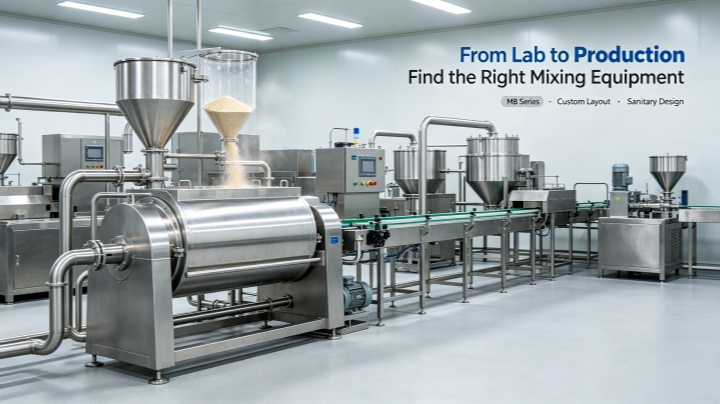
A well‑specified ribbon blender can be a reliable workhorse in your food additive production line for 20 years or more. By carefully considering your material characteristics, uniformity requirements, sanitary needs, and operational parameters, you can select equipment that delivers consistent, high‑quality blends batch after batch—and provides a solid return on your investment.


Address:China,Yanjin county forest park gate to the west 1000 meters north road.


 Online Chat
 Email
Email