


When pigments fail to disperse properly, manufacturers face color inconsistency, poor color strength, batch‑to‑batch variability, increased production time, and higher raw material costs. These issues do not just affect product quality—they damage brand reputation and reduce profitability.
The good news is that most dispersion problems can be solved not by changing pigments, but by optimizing equipment selection and process parameters. This guide explains how to identify and fix uneven pigment dispersion issues through proper high‑speed disperser selection and process optimization.
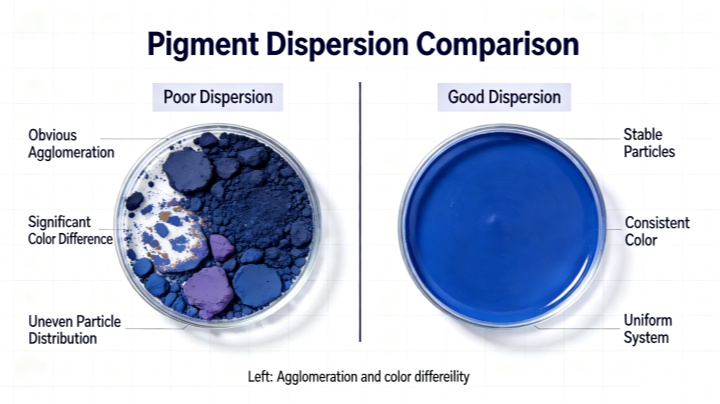
Before selecting equipment, it helps to understand why pigment dispersion fails. Common root causes include insufficient shear force to break down pigment agglomerates, improper blade‑to‑vessel ratio that fails to create effective flow patterns, incorrect viscosity window that prevents proper circulation, poor powder wet‑out due to weak vortex formation, and inconsistent process control across batches.
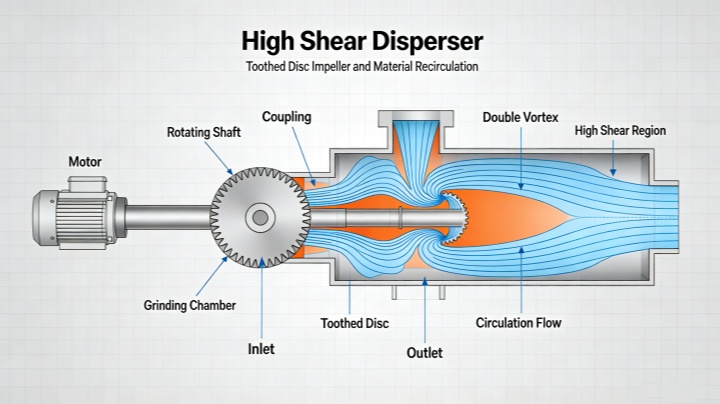
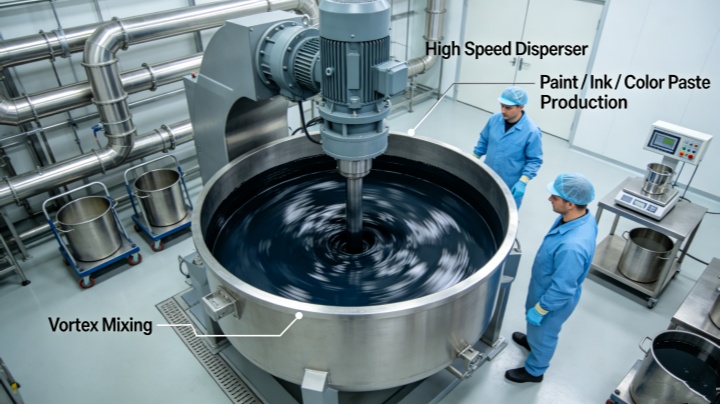
High‑speed dispersers address these problems by generating intense shear forces through a saw‑tooth disc impeller. Unlike standard agitators that can only maintain already‑dispersed mixtures, dispersers actively break apart agglomerates and create dispersions.
High‑speed dispersers transform rotational energy into mixing power through a specialized mechanism. The disc‑mounted blade at the shaft base rotates at calculated velocities, creating measurable tip speed, which is calculated as peripheral velocity equals 3.14 multiplied by diameter in meters multiplied by RPM. This rotation generates powerful suction forces, pulling materials toward the mixing zone. The rotation creates dual vortices above and below the disc, where intense energy transfer occurs upon material contact with the blade. This energy transfer creates dramatic velocity differentials throughout the mixture, generating shear forces that tear material layers apart.
For pigment dispersion, tip speed is critical. The target tip speed for medium‑viscosity materials in the range of 1,500 to 5,000 centipoises is approximately 1,525 meters per minute. Reduce tip speeds for higher‑viscosity materials and increase for lower‑viscosity materials.
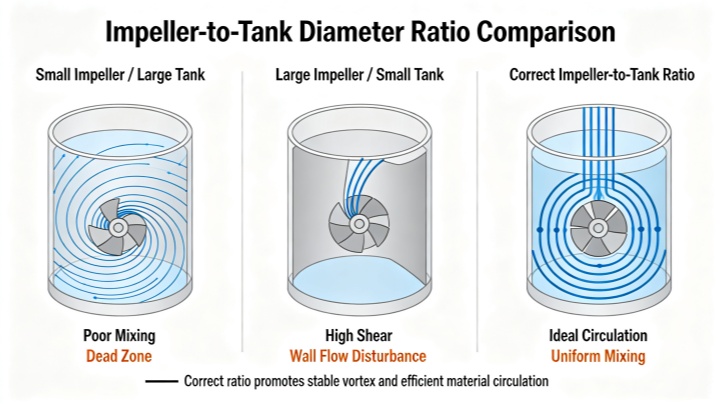
Blade diameter should be approximately one‑third of vessel diameter. Specific ratios by material type are as follows. For dense, flowable pastes, the recommended blade‑to‑tank ratio is 0.5 to 1. For standard materials such as paint, the ratio is 0.33 to 1. For low‑viscosity formulations, the ratio can be as low as 0.125 to 1. A practical example is that a 1.8‑meter tank using the 0.33 to 1 ratio requires a 0.6‑meter blade.
High‑speed dispersers operate effectively within a specific viscosity window. The normal operating range is between 1,000 and 25,000 centipoises, with a maximum viscosity of up to 50,000 centipoises. Excessive viscosity prevents material circulation between blade and tank wall, while insufficient viscosity fails to generate adequate layer separation.
Power demand increases exponentially with blade diameter. Doubling blade diameter from 30 centimeters to 60 centimeters might increase power requirements fivefold, for example from 15kW to 75kW. A general guideline is 1 horsepower for every 10 gallons of product.
The blade should be positioned at a minimum of 0.5 blade diameter off the vessel bottom. This ensures proper vortex formation and prevents dead zones.
Optimal manufacturing vessels feature a height slightly exceeding width, not a squat design. They should have curved or bowl‑shaped bottoms that prevent material accumulation, centered drainage points for complete evacuation, and flush‑mounted discharge valves for efficient emptying and cleaning.
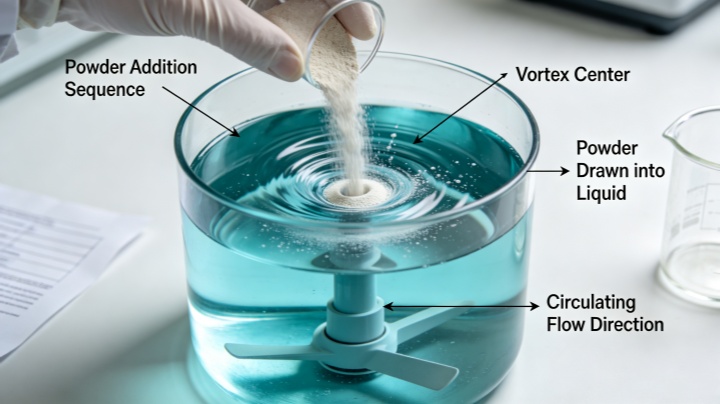
The sequence of adding materials dramatically impacts results. Start by adding approximately half of total powders rapidly into the liquid vehicle. Then introduce remaining powders with progressively decreasing speed. Adjust blade speed from 50 percent of final tip speed initially, increasing to maximum as the batch thickens.
The optimal performance indicator is a toroidal, or doughnut‑shaped, flow pattern with the blade positioned at the center void. This indicates proper circulation and shear distribution.
High‑speed dispersers are sensitive to fill level. Keep the blade properly submerged. Avoid overfilling, which suppresses vortex formation, and avoid underfilling, which increases air entrainment. Correct working volume is critical for repeatable dispersion. Full holding capacity of the mix vessel should be about 130 percent of batch size.
Well‑formulated batches should achieve maximum dispersion within 20 to 30 minutes after final ingredient addition. Extended processing rarely improves dispersion quality and may increase thermal load.
The primary challenges in this application area are pigment wet‑out, agglomerate breakdown, and color strength and consistency. The typical workflow begins with liquid phase charging, where resins, solvents, or water‑based carriers are loaded. Next is pigment and filler addition, where solids are drawn into the vortex for wet‑out. This is followed by high‑speed dispersion, where agglomerates are broken down through shear. When required, the batch is transferred to a bead mill for fine particle size reduction, and finally downstream letdown is performed. Rapid wet‑out prevents floating, clumping, and color inconsistency.
The primary challenges here are high pigment loading, uniform dispersion, and color repeatability. The typical workflow includes carrier preparation, followed by high‑speed dispersion for wet‑out, then bead milling for fine particle size if needed, and finally transfer to packaging or letdown. Dispersers handle bulk incorporation efficiently before fine milling.
In this application, dispersers reduce load on downstream planetary mixers and improve final uniformity.
For consistent, high‑quality pigment dispersion, manufacturers should follow a series of key practices. Begin with thoroughly cleaned equipment. Verify correct blade‑to‑tank proportions. Follow engineered formulation protocols. Select appropriate blade design in optimal condition. Operate at maximum suitable blade‑tip velocity. Ensure tank geometry meets requirements. Supply sufficient power capacity. Implement proper material addition techniques. Maintain appropriate rheological parameters.
Watch for these signs that your disperser needs attention. Increased processing time beyond 30 minutes often indicates blade wear. Replace saw‑tooth blades when tips wear to 50 percent of original height. If dispersion quality decreases without formulation changes, inspect blade condition.
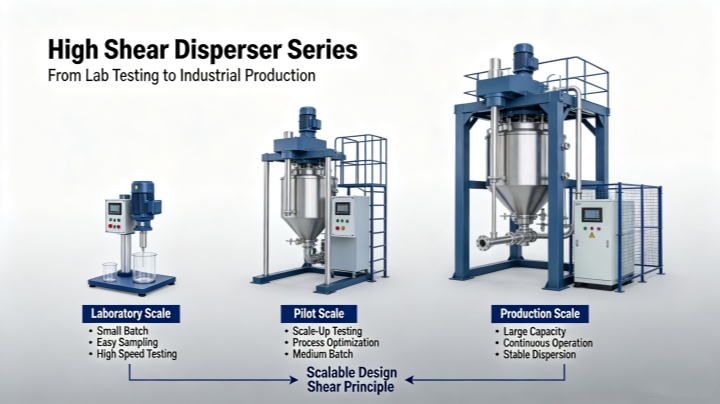
When scaling from laboratory to production, focus on matching tip speed, preserving blade‑to‑vessel geometry ratios, scaling power density appropriately, and managing heat removal capacity. Dispersion physics scale reliably when tip speed and geometry are preserved.
Uneven pigment dispersion is a solvable problem. By selecting the right high‑speed disperser with correct blade‑to‑tank ratio, appropriate power, proper vessel design, and by following proven process optimization techniques, you can achieve consistent color strength batch after batch, reduced processing time and energy consumption, lower raw material costs through efficient pigment use, and improved final product quality and brand reputation.
For detailed technical specifications and model selection, please visit our product page.


Address:China,Yanjin county forest park gate to the west 1000 meters north road.


 Online Chat
 Email
Email