


Choosing the right powder mixing equipment is a critical decision that directly impacts product quality, production efficiency, and operational costs. For dry powder and granule blending applications, the V‑Type Powder Mixer—also known as a V‑shaped blender or tumble blender—stands out as a preferred solution across pharmaceutical, food, chemical, and cosmetic industries worldwide. This comprehensive guide walks you through everything you need to know: from how it works to the key technical parameters that determine the right model for your specific process.
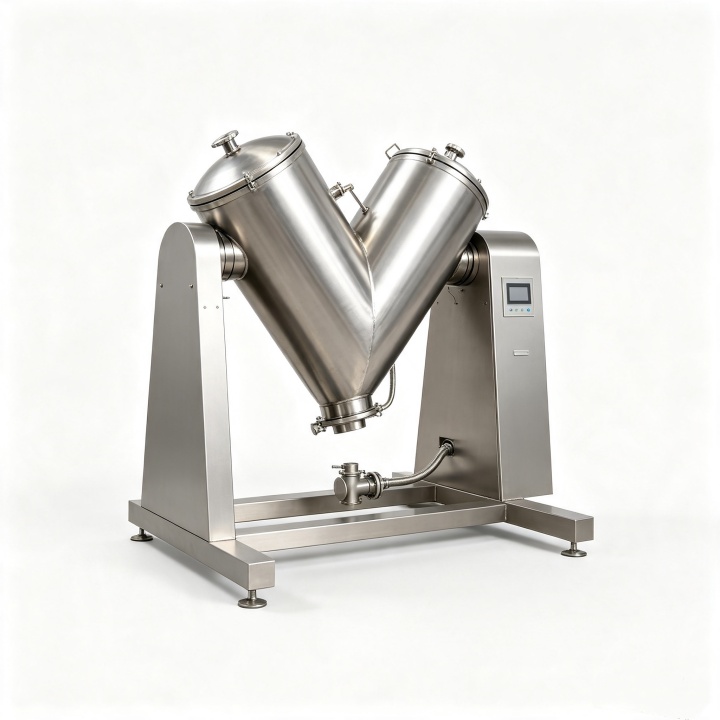
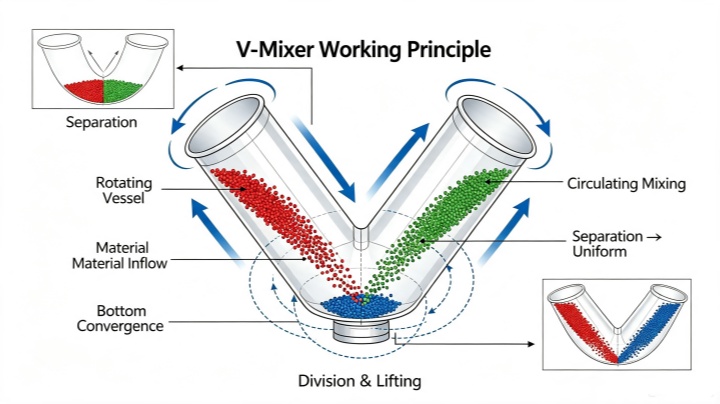
The V‑Type powder mixer operates on a fundamentally simple yet highly effective principle: gravity‑assisted diffusion mixing. Unlike mechanical agitators that rely on high‑shear forces, the V‑shaped chamber rotates on a horizontal axis, continuously splitting and recombining the material stream.
As the vessel rotates at speeds typically ranging from 5 to 25 revolutions per minute (RPM), the powder inside undergoes a cascading motion: materials flow from the two converging arms into the V‑shaped bottom, then split again as the chamber continues to rotate. This creates a repetitive "divide‑converge‑convection" cycle that achieves homogeneous blending in as little as 5 to 20 minutes per batch, depending on material characteristics.
The V‑Type mixer's design offers distinct advantages that make it the go‑to choice for specific applications:
Gentle on Fragile Materials: The low‑impact tumbling action preserves particle integrity, making it ideal for friable, easily broken, or heat‑sensitive materials. This is particularly critical for high‑value active pharmaceutical ingredients (APIs) and delicate food ingredients.
No Dead Zones: The V‑shaped geometry eliminates unmixed pockets that can occur in cylindrical or trough‑style mixers, ensuring every particle is exposed to the mixing action.
Complete Discharge: The V‑shape and bottom discharge valve allow for near‑complete emptying of the vessel, typically achieving residual rates below 5%. This minimizes product waste and simplifies cleaning between batches.
Energy Efficiency: Operating at low rotational speeds, V‑Type mixers consume significantly less energy compared to high‑shear alternatives, reducing long‑term operating costs.
Proven for Precise Blends: The diffusion mixing mechanism is widely proven in pharmaceutical manufacturing for achieving uniform distribution of trace components (<1%) and ingredients with vastly different particle sizes and densities.
Making the right selection requires a systematic evaluation of your production needs, material properties, and operational environment. Here are the critical factors to consider.
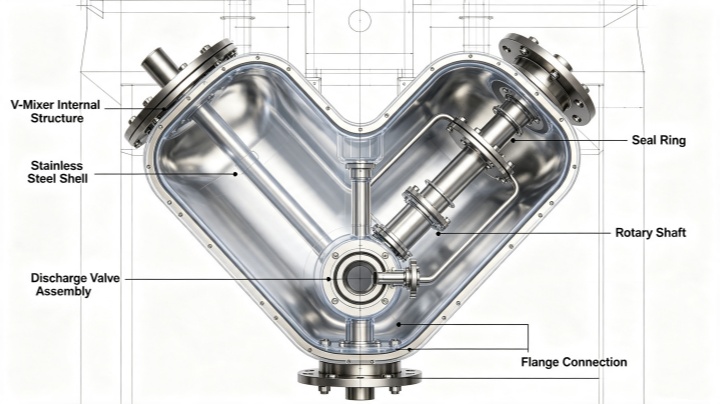
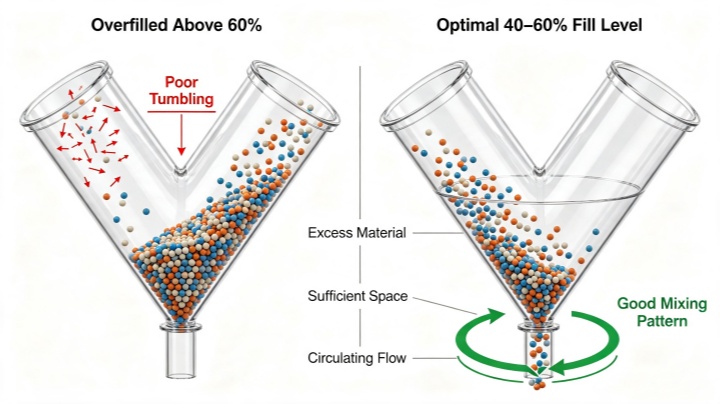
The first and most fundamental decision is capacity. V‑Type mixers are available in a wide range of sizes, from 5L to 30,000L total volume, with working capacity typically at 40% to 60% of total volume.
| Model | Total Volume (L) | Working Capacity (L) | Working Capacity (kg)* | Rotation Speed (rpm) | Power (kw) |
| CMPV‑300 | 300 | 150 | 90 | 20 | 1.1 |
| CMPV‑500 | 500 | 250 | 150 | 18 | 1.5 |
| CMPV‑1000 | 1000 | 500 | 300 | 15 | 3 |
| CMPV‑2000 | 2000 | 1000 | 600 | 12 | 5.5 |
| CMPV‑5000 | 5000 | 2500 | 1500 | 8 | 7.5 |
| CMPV‑10000 | 10000 | 5000 | 3000 | 6 | 18.5 |
Based on material with bulk density of ~0.6 g/cc; actual capacity depends on your material's specific density.
Selection Tip: Determine your target batch weight and divide by the material's bulk density to calculate the required working volume. Choose a model where this volume falls within 40‑60% of total vessel capacity for optimal mixing efficiency.
Understanding your material is perhaps the most critical step in the selection process. Two products that appear similar can require entirely different mixing approaches because their particles behave differently under movement and compression.
Key properties to document:
Particle Size Distribution: Fine powders, granular materials, and blends with wide size differences all behave differently. V‑Type mixers are generally recommended for materials with good flowability and minimal particle size variation.
Bulk Density (kg/m³ or g/cc): This determines not only the working capacity but also the motor horsepower required. Provide accurate bulk density data for all formulations you plan to process, as this is critical for proper motor sizing.
Flowability and Cohesiveness: Highly cohesive powders may require additional features like intensifier bars to break up agglomerates.
Moisture Content: V‑Type mixers can handle materials with some moisture, but high moisture or hygroscopic materials may require specialized configurations like vacuum drying or jacketed vessels.
Fragility: If your particles are easily broken or worn, the gentle tumbling action is a major advantage over high‑shear mixers.
The construction material directly impacts product purity, corrosion resistance, and cleanability.
Stainless Steel 304: The standard choice for general applications, offering good corrosion resistance and cleanability
Stainless Steel 316L: Recommended for pharmaceutical, food, and chemical applications where higher corrosion resistance is required, particularly for materials with acidic or saline properties.
Surface Finish: Polished or mirror finishes on all product‑contacting surfaces improve cleanability and sanitation, which is essential for GMP‑compliant pharmaceutical and food applications.
Discharge Valves: Manual butterfly valves are standard, but pneumatic or motorized valves may be preferred for automated production lines.
Cleaning Access: V‑Type mixers are generally easy to clean due to their simple geometry and accessible interiors. For applications requiring rapid changeovers, consider CIP (Clean‑in‑Place) ready configurations.
Fixed vs. Variable Speed: While fixed‑speed operation is standard, a variable frequency drive (VFD) is typically recommended. It allows for soft‑start under full load, adjustment of rotation speed to optimize the cascading action for different materials, and automatic shutdown after a set number of revolutions for consistent batch‑to‑batch quality.
Automation Integration: For demanding processes, PLC systems can be integrated to program multiple mixing steps, manage recipes, and enable remote monitoring.
Depending on your specific application, consider these optional features:
Intensifier Bar: A high‑speed bar installed along the axis of rotation to break down tough lumps or agglomerates that the gentle tumbling action cannot handle.
Liquid Addition System: Spray nozzles installed on the intensifier bar allow for uniform liquid addition, coating, or agglomeration control.
Jacketed Vessel: Allows for heating or cooling during the mixing cycle, beneficial for temperature‑sensitive materials or drying applications.
Explosion‑Proof Components: Essential for processing flammable powders in hazardous environment.
Vacuum Capability: For vacuum drying or processing under inert conditions to prevent oxidation.
Understanding the key specification terms will help you make an informed decision:
| Specification | What It Means | Why It Matters |
| Total Volume | The total internal capacity of the V‑shaped vessel. | Defines the physical size of the machine. |
| Working Capacity | Typically 40‑60% of total volume. This is the recommended fill level for optimal mixing. | Overfilling reduces mixing efficiency; underfilling may not activate proper cascading. |
| Rotation Speed (rpm) | The rotational speed of the vessel during operation. Typically 6‑20 rpm. | Lower speeds are gentler; higher speeds reduce mix time but can stress materials. |
| Motor Power (kw) | The electrical power required to drive the mixer. | Must be sufficient for the batch weight and density. Oversizing improves reliability. |
| Weight | The net weight of the machine. | Critical for installation planning and floor loading. |
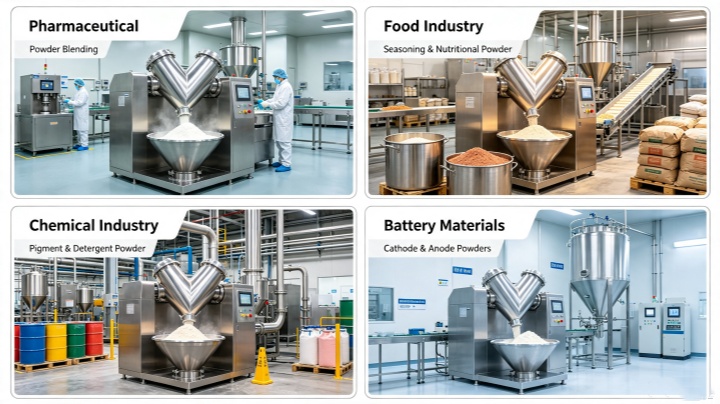
V‑Type powder mixers are trusted across diverse industries due to their versatility and gentle, precise mixing:
| Industry | Typical Applications |
| Pharmaceutical | API blending, tablet granulation, dry powder formulations, capsule filling materials |
| Food & Nutraceutical | Spice blends, nutritional powders, protein powders, baking ingredients, food additives |
| Chemical | Detergent powders, pigment blending, plastic additives, chemical intermediates |
| Cosmetics | Face powder, eyeshadow, talc‑based products, cosmetic pigments |
| Battery Materials | Cathode/anode powder mixing for lithium‑ion batteries |
| Agriculture | Feed additives, pesticide powders, seed treatments, fertilizer mixes |
Choosing Capacity by Weight Alone: Always calculate required volume using your material's bulk density. A 500kg batch of heavy powder requires a different vessel size than 500kg of light powder.
Ignoring Discharge Segregation: Re‑segregation during discharge can undo the mixing achieved in the vessel. Use slow, controlled discharge rates and consider continuous sampling for critical applications.
Assuming "Similar" Means "Same": A small difference in moisture content, fat content, or particle shape can significantly change mixing behavior. Always test with your actual material.
Underestimating Cleanout Requirements: If you run multiple products, easy cleaning is essential. Ensure the design allows for thorough cleaning and consider CIP options.
Overlooking Scale‑Up Challenges: A process that works in a pilot vessel can behave differently at production scale. Work with your equipment supplier to ensure a smooth transition.
Selecting the optimal V‑Type Powder Mixer for your application requires careful consideration of your unique material properties and production goals. To receive a tailored recommendation, please provide us with:
Material name (what are you mixing?)
Particle size (mesh size, mm, or micron range)
Bulk density (kg/m³ or g/cc)
Batch size (how many kgs per batch?)
Our engineering team will analyze your requirements and recommend the ideal capacity, speed, and customization options for your specific process.


Address:China,Yanjin county forest park gate to the west 1000 meters north road.


 Online Chat
 Email
Email