


Ribbon Mixer Blender features a U‑shaped horizontal trough and double helical ribbon agitators. The working volume is 70‑80% of the total trough capacity, and batch sizes range from 50 litres up to 20,000 litres. The core strengths of this unit are its convective mixing mechanism and gentle material handling, making it suitable for homogeneous blending of powders and granules. Under standard conditions, the coefficient of variation for mixing uniformity can be controlled within 3%.
Technical parameters and performance data in this article are compiled by industry professionals, based on factory test reports and actual operating records.
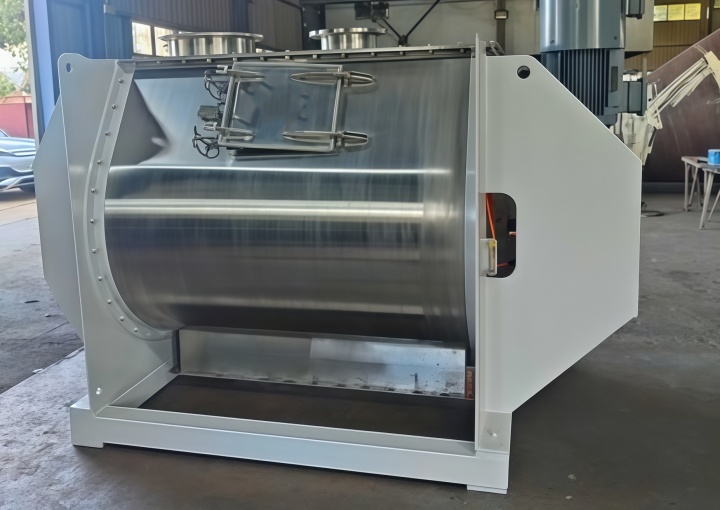
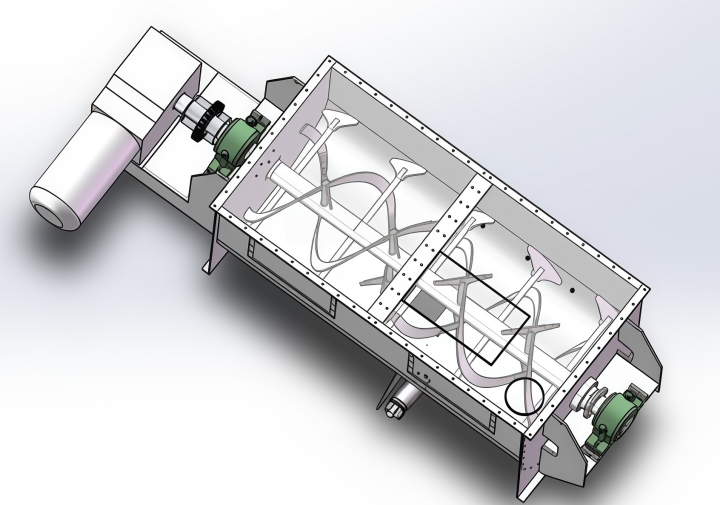
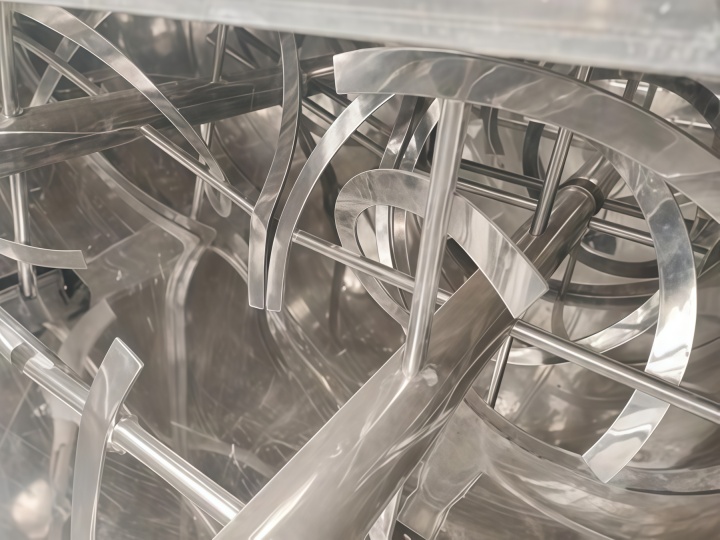
The key component is a horizontal shaft fitted with two sets of opposed helical ribbons – an inner and an outer ribbon. During operation, the outer ribbon pushes material from both ends toward the centre, while the inner ribbon moves it from the centre toward the ends. This dual‑action convective flow creates both axial and radial movement inside the trough. The clearance between the ribbon edge and the trough wall is kept at 2‑5 mm, allowing thorough turnover and minimising dead zones. A standard machine typically completes one batch in 5‑20 minutes.
Actual tests on a 200‑litre model show that at a fill rate of 75% and a bulk density of 35 lb/ft³, the coefficient of variation drops below 3% after four minutes of mixing (test conditions: 25°C, 60% humidity). The same model showed ribbon wear of less than 0.3 mm after 1,000 operating hours.
An industry case: a food additive manufacturer replaced its pneumatic mixer with a 200‑litre Ribbon Mixer Blender. Single‑batch time decreased from about 18 minutes to 6 minutes, and monthly output rose by roughly 40%, with no leakage after months of continuous operation. These figures reflect typical performance levels for this machine in real‑world applications.
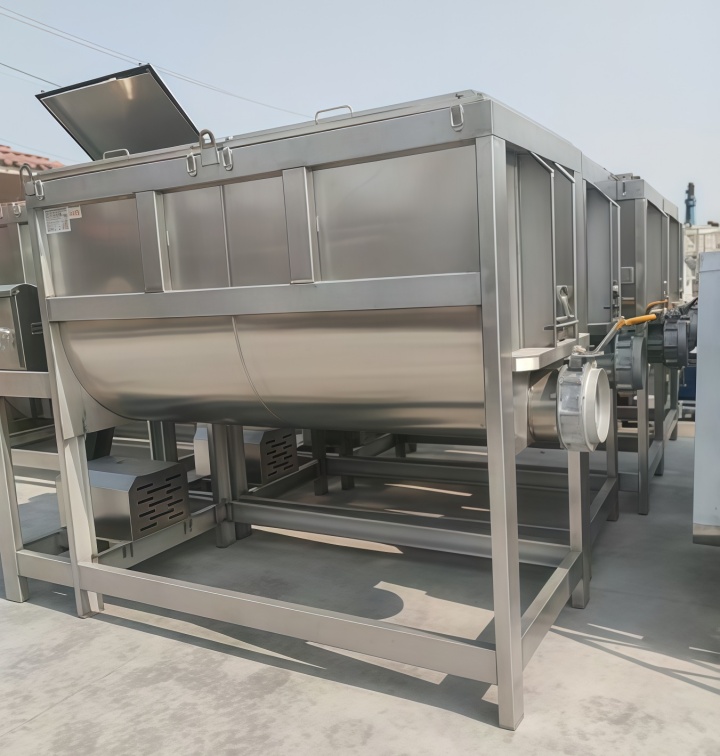
The strengths of this blender lie in four areas: mixing efficiency, material protection, discharge capability, and maintenance convenience. The following table summarises each advantage.
| Advantage Area | Specific Performance |
|---|---|
| Mixing efficiency | Achieves over 95% uniformity in a relatively short time |
| Material protection | Tip speed controlled at 100-150 m/min, gentle on fragile and friable particles |
| Discharge ability | U-shaped trough with full-opening bottom outlet gives over 99% evacuation, reducing residue and cross-contamination |
| Easy maintenance | Simple construction; main wear parts are ribbons and seals; service intervals up to 2,000 hours |
Selecting the right Ribbon Mixer Blender requires careful consideration of volume, power, and material properties. The table below lists typical parameters for five common models, which serve as a reference during selection.
| Parameter | Model A | Model B | Model C | Model D | Model E |
|---|---|---|---|---|---|
| Working volume | 200 L | 500 L | 1000 L | 2000 L | 5000 L |
| Total volume | 284 L | 692 L | 1286 L | 2475 L | approx. 7000 L |
| Agitator speed | 46 rpm | 46 rpm | 46 rpm | 46 rpm | 22-33 rpm |
| Motor power | 4 kW | 7.5 kW | 11 kW | 22 kW | 45-55 kW |
| Net weight | 250 kg | 500 kg | 700 kg | 1300 kg | 5000-6000 kg |
| Dimensions (L×W×H) | 1370×834×1647 mm | 1773×1100×1855 mm | 2394×1320×2187 mm | 3080×1625×2453 mm | 5100×1720×2500 mm |
Contact parts can be made of carbon steel, 304 or 316L stainless steel, with trough plate thickness of 3‑6 mm. Optional extras include pneumatic discharge gates, spray nozzles, heating/cooling jackets, explosion‑proof motors, and variable frequency drives.
Selection tips: Models B and C suit most food and chemical production. If bulk density exceeds 50 lb/ft³, choose a higher‑power Ribbon Mixer Blender. For light powders under 20 lb/ft³, variable speed is recommended to reduce dusting. Hard‑particle materials require hardened ribbons.
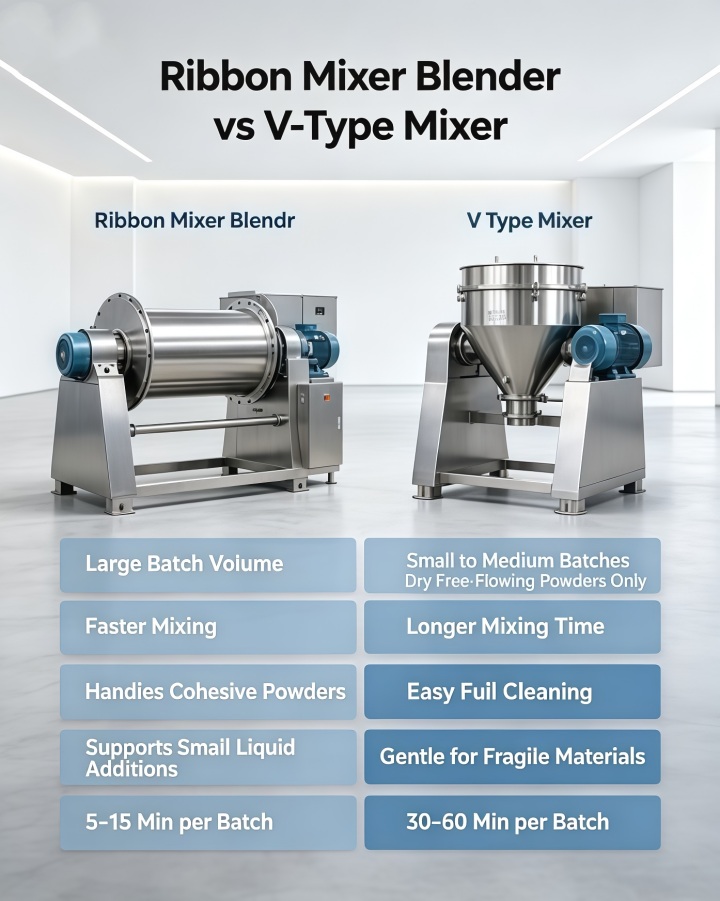
Ribbon Mixer Blender is designed for large‑volume production, with single‑batch capacities far exceeding those of V‑type mixers; mixing times are typically 5‑15 minutes compared to 30‑60 minutes for a V‑type. The former can handle cohesive powders and small liquid additions, while the latter is limited to dry, free‑flowing powders. V‑type mixers have no internal agitators, making cleaning easier and offering better protection for friable materials. The choice between a Ribbon Mixer Blender and a V‑type mixer depends on batch size, material characteristics, and cleaning priorities.
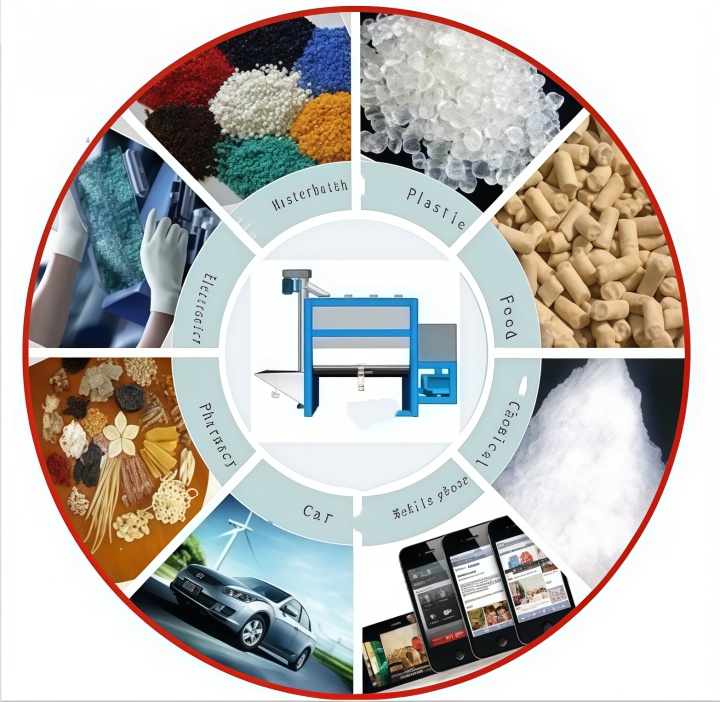
The suitability of this blender is determined by material properties – different materials require different specifications, speeds, and configurations. Below are four typical material categories with handling recommendations.
| Material Type | Typical Examples | Handling Tips for Ribbon Mixer Blender |
|---|---|---|
| Dry powders & granules | Seasonings, flour, protein powders, masterbatches, plastic additives, dry mortar, putty powder, fertilisers, feed | High mixing uniformity; standard configuration suffices |
| Fragile & friable | Freeze-dried fruit powders, fragile crystalline APIs, ceramic precursor powders | Low-speed operation reduces breakage |
| Fibrous & light | Grass meal, dietary fibre powders, wood fibre additives | Use with variable frequency drive for even mixing |
| Moist (with small liquid) | Wettable pesticide powders, oil-sprayed pellets, flavour spraying | Liquid addition ≤10-15% of total weight |
For abrasive materials like quartz sand, the unit should be fitted with wear‑resistant liners and hardened ribbons.
Proper installation and upkeep directly affect operational stability and service life. During installation, ensure the base is level, with a trough levelness error not exceeding 0.5 mm per metre. Before first use, run an idling test for 30 minutes to check for abnormal noise and temperature rise. For routine operation, three maintenance tasks must be performed regularly:
Every shift – check seals for leaks
Every month – calibrate discharge gate closure
Every quarter – change gearbox lubricating oil
After 500 hours of operation, measure the ribbon clearance; if the gap between ribbon and wall exceeds 8 mm, repair or replacement is needed. If abnormal vibration occurs during operation, first check for foreign matter wrapped around the ribbons or worn bearings. Poor discharge may be due to damp agglomeration or aged discharge gate seals. A well‑maintained Ribbon Mixer Blender typically enjoys extended trouble‑free operating periods.
Is a Ribbon Mixer Blender noisy during operation?
At full load, noise levels are typically 75‑85 dB, comparable to urban street traffic.
How often should wear parts of a Ribbon Mixer Blender be replaced?
Ribbons and seals should be inspected every 2,000 operating hours under normal conditions; replacement intervals depend on material abrasiveness.
Can a Ribbon Mixer Blender handle heat‑sensitive materials?
Yes – the unit can be equipped with a cooling jacket to control temperature rise during mixing via circulating cooling water.
What is the minimum working capacity of a Ribbon Mixer Blender?
The working volume should not fall below 30% of the total trough volume; otherwise, the material cannot make proper contact with the ribbons.


Address:China,Yanjin county forest park gate to the west 1000 meters north road.


 Online Chat
  Email
Email