


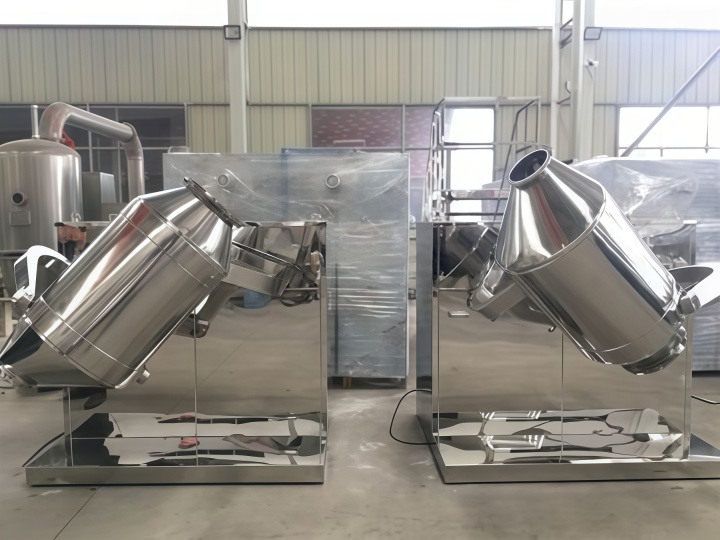
Three-Dimensional Motion Mixer is industrial equipment that utilizes multi-axis compound spatial motion to achieve high-uniformity mixing of powders, with the SYH series as the mainstream model and a volume range covering 1 to 2000 liters. The mixing drum is manufactured from AISI 304 or 316L stainless steel with an internal surface roughness reaching Ra 0.4 micrometers or below, meeting GMP cleanliness standards.
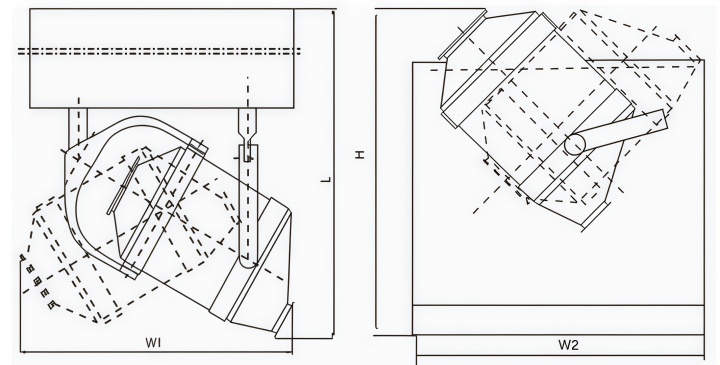
Different from conventional single-axis rotating mixing equipment, this device drives the mixing drum through a drive shaft and universal transmission mechanism to perform continuous displacement and rotation along the X, Y, and Z axes.
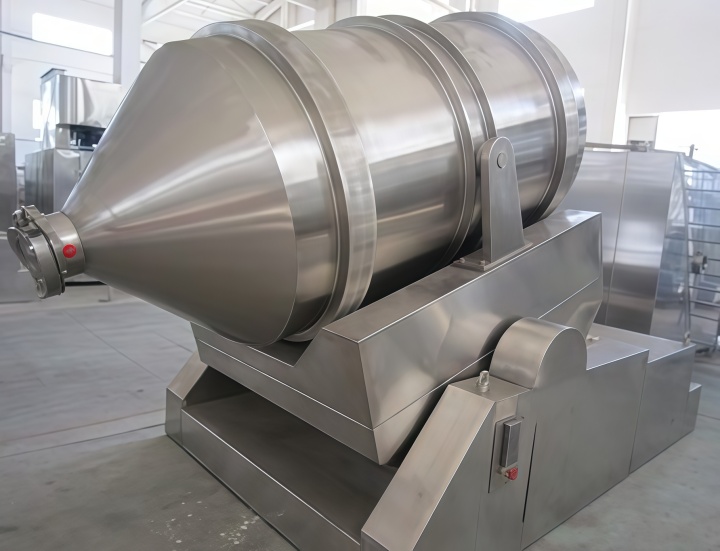
Three-Dimensional Motion Mixer operates with the drum swinging around the horizontal axis while simultaneously rotating around the vertical axis, with the drive shaft speed set at 0 to 15 revolutions per minute, a horizontal swing angle reaching ±60 degrees, and a vertical tilt angle reaching ±30 degrees. This compound motion enables the materials inside the drum to undergo continuous alternating cycles of diffusion mixing and shear mixing. The materials inside the drum exhibit a superposition of three motion states including rotational flow, translational displacement, and tumbling fall.
Three-Dimensional Motion Mixer generates minimal centrifugal force during operation and does not throw materials of different densities toward the drum wall to cause stratification, which serves as the technical basis for its superior performance over other machine types when handling materials with significant specific gravity differences.
The mixing efficiency of this device can be precisely quantified through sampling tests under fixed conditions. Taking the SYH-100 model as an example, using starch with a bulk density of 0.6 grams per cubic centimeter as the test material, with a loading capacity of 75 kilograms and a spindle speed of 12 revolutions per minute, the average CV value from three sampling points at the upper, middle, and lower positions after 8 minutes of operation was 2.3%, corresponding to a uniformity rate of 99.77%. After 10 minutes of operation, the CV value decreased to 1.8%.
When the same batch of starch was run on a V-100 V-type mixer and a GH-100 double-cone mixer with the same loading coefficient for 10 minutes, the CV values were 5.2% and 4.7% respectively. The three sets of comparative data indicate that Three-Dimensional Motion Mixer demonstrates superior uniformity stability over traditional single-axis motion mixing equipment when handling easily separable materials.
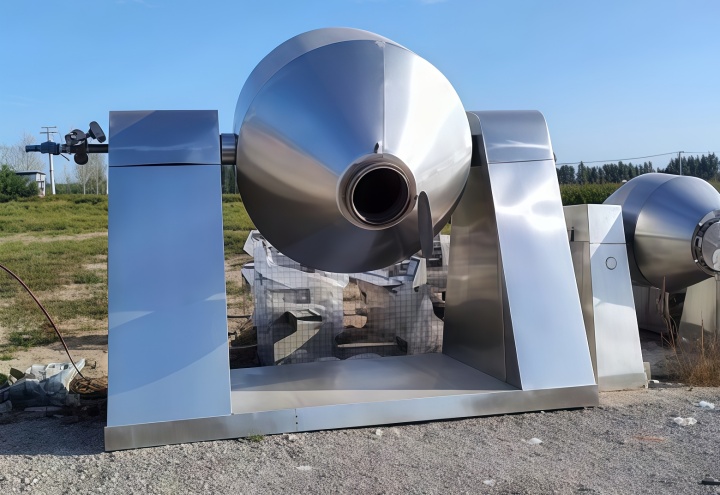
The core dimensions and power parameters for each model of Three-Dimensional Motion Mixer are shown in the table below, with the overall dimension data providing direct reference for users to reserve installation space.
| Model | Drum Volume L | Loading Volume L | Loading Weight kg | Spindle Speed r/min | Motor Power kw | Overall Dimension L×W×H mm | Machine Weight kg |
| SYH-1 | 1 | 0.8 | 0.5 | 15-30 | 0.12 | 500×600×600 | 50 |
| SYH-5 | 5 | 4 | 2.4 | 0-20 | 0.25 | 600×1000×1000 | 150 |
| SYH-50 | 50 | 40 | 25 | 0-20 | 1.1 | 1150×1400×1000 | 300 |
| SYH-100 | 100 | 80 | 75 | 0-15 | 1.5 | 1200×1800×1500 | 500 |
| SYH-200 | 200 | 160 | 160 | 0-15 | 2.5 | 1300×1600×1500 | 750 |
| SYH-400 | 400 | 320 | 320 | 0-15 | 4 | 1500×2200×1500 | 1200 |
The actual loading weight of the Three-Dimensional Motion Mixer needs to be converted based on the material bulk density, with the values in the table calculated using common materials with a bulk density of approximately 1.0 gram per cubic centimeter as the benchmark.
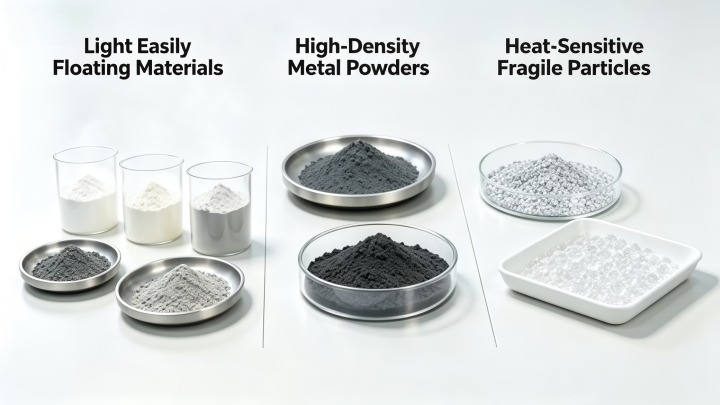
Three-Dimensional Motion Mixer leverages its low-speed high-torque output and three-dimensional spatial tumbling motion characteristics to provide differentiated mixing solutions for materials with different bulk densities, particle sizes, and thermal sensitivities, demonstrating superior adaptability over traditional mixing equipment across three typical material categories.
Lightweight and easily floating materials: The low-speed high-torque design of the Three-Dimensional Motion Mixer effectively prevents dust flying and stratification of lightweight materials such as traditional Chinese medicine extract powders, spray-dried milk powder, and ultrafine carbon powder, ensuring that the lightweight components do not escape and maintain uniform distribution during the mixing process.
High-density metal powders: This device overcomes gravity segregation differences between metal powder particles such as tungsten powder, iron powder, and rare earth permanent magnet materials through three-dimensional tumbling motion, effectively avoiding bottom segregation issues caused by density differences that occur with traditional equipment.
Heat-sensitive and fragile particles: The product does not generate shear force or frictional temperature rise during the mixing process, and can fully preserve the original morphology and particle size distribution of enzyme preparation carriers, seasoning crystals, and polymer particles. This characteristic creates a distinction from high-shear mixing equipment in high-value heat-sensitive material applications.
Selecting Three-Dimensional Motion Mixer requires quantitative calculations based on material bulk density and batch output. Measure the material bulk density ρ in grams per cubic centimeter, determine the single-batch target output Q in kilograms, and calculate the theoretical volume V based on an upper loading coefficient limit of 85%, with the formula V equals Q divided by ρ divided by 0.85, with the result in liters. Match the calculated V value upward to the corresponding drum volume model in the technical specification table.
Taking a pigment with a bulk density of 0.8 grams per cubic centimeter and a single-batch mixing requirement of 200 kilograms as an example, the theoretical volume is approximately 294 liters, so the SYH-400 model should be selected. Verify the overall dimensions of the selected model to ensure a minimum of 800 millimeters of operating clearance is reserved on all sides of the installation position.
How long does the Three-Dimensional Motion Mixer need to run to achieve a good mixing effect?
Based on measured data from the SYH-100 mixing starch, the CV value was 2.3% at 8 minutes, decreased to 1.8% at 10 minutes, and stabilized at 1.7% with no further decrease after 12 minutes. Users should conduct timed sampling tests with actual production materials to determine the appropriate mixing time for that specific material.
How often do the transmission components of the Three-Dimensional Motion Mixer need maintenance?
The main shaft bearings should be inspected for clearance and lubricating grease replenished every 2,000 accumulated operating hours under continuous daily operation. The universal joint requires high-temperature lithium-based grease application every 1,000 hours, and it is recommended to establish an equipment operation log to track the actual replacement cycle.
What are the specific installation floor requirements for the Three-Dimensional Motion Mixer?
The SYH-400 model has a machine weight of 1,200 kilograms, and with 320 kilograms of material loading, the total static load exceeds 1.5 tons. The installation floor should be C30 concrete hardened ground with a thickness of no less than 200 millimeters, with a flatness error not exceeding 3 millimeters per square meter.
How does the Three-Dimensional Motion Mixer handle drum wall adhesion issues with sticky materials?
For materials with high moisture content or oils and fats, up to one percent of the total material weight of fumed silica can be added as a flow aid before mixing. Cleaning while the drum body is still warm after production can reduce material solidification adhesion in the arc transition areas.
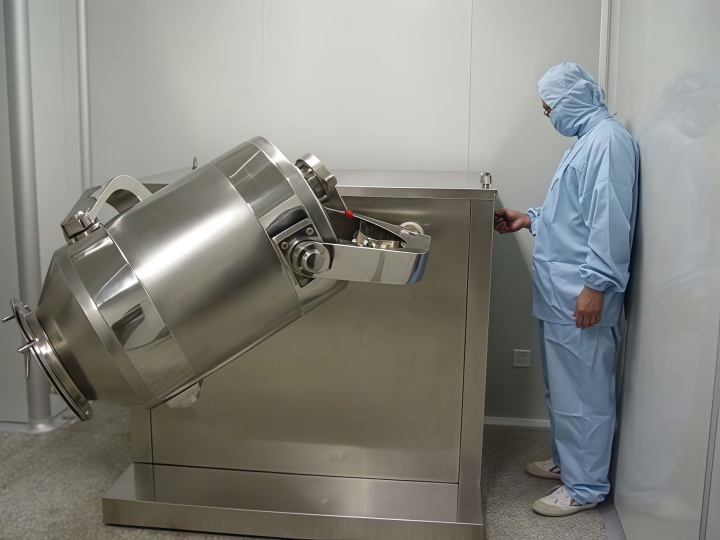
By providing the material name, target batch output, and existing process issues, you can receive model recommendations and estimated CV value ranges for that specific material. A database of mixing parameters for over 200 different materials has been accumulated, covering four major categories including pharmaceutical excipients, chemical pigments, food additives, and metal powders.


Address:China,Yanjin county forest park gate to the west 1000 meters north road.


 Online Chat
 Email