


Uneven mixing can lead to product quality issues, failed batches, and significant financial losses. If you're facing inconsistent blends, segregation, or particle degradation, understanding the science behind an effective mixing solution is key. The double cone rotary mixer offers a powerful and elegant answer to these common problems through its unique, gentle tumbling action.
Before exploring the solution, it's essential to understand why blends fail. The primary culprit is segregation, also known as demixing. This occurs when particles with different physical properties—such as size, density, or shape—separate from one another during processing or handling. This separation is often driven by gravity, air currents, or shear forces within the powder bed.
Common reasons for uneven mixing include:
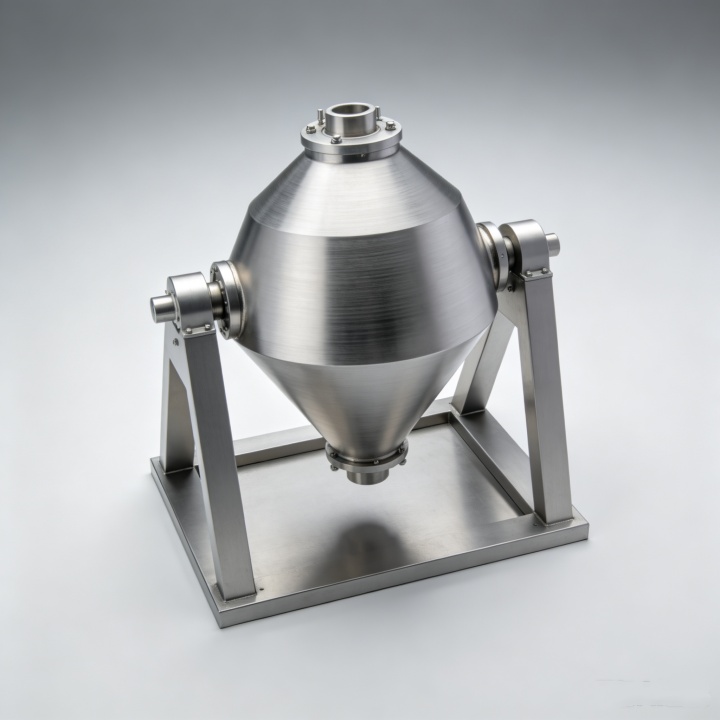
The double cone rotary mixer solves these issues through a fundamentally different approach: gravity‑driven, low‑energy tumbling. Its distinctive, symmetrical "hourglass" shape—formed by two conical sections joined at their wide ends—is key to its effectiveness.
As the vessel rotates slowly on its horizontal axis, the powder mass is continuously lifted by the wall and then cascades downward in a gentle, rolling avalanche. This creates a powerful, three‑dimensional folding action without the need for internal agitators that can cause shear and heat buildup. This process utilizes three simultaneous mixing mechanisms to achieve a superior blend:
To unlock the full potential of a double cone mixer, controlling a few critical parameters is essential. These factors directly influence the quality and uniformity of your final blend:
The Issue: If the speed is too slow, there is insufficient agitation for effective mixing. If it's too fast, centrifugal force will pin the material to the vessel wall, preventing the crucial cascading action.
The Solution: The optimum speed creates the "avalanching" flow, allowing the material to tumble freely. Typical speeds for double cone mixers range from 5 to 20 RPM, depending on the model and material.
The Issue: Overfilling restricts the powder's ability to move and tumble, leading to dead zones and poor mixing.
The Solution: The ideal working volume for a double cone mixer is typically 50% to 65% of the total vessel volume. This provides ample space for the material to cascade and fold effectively.
The Issue: More time is not always better. Over‑blending can lead to particle attrition and can even promote segregation in some materials.
The Solution: The optimal mix time must be determined experimentally for each specific formulation. However, many free‑flowing powders achieve a high degree of uniformity (a coefficient of variation, or CV, of ≤5%) within 10 to 20 minutes.
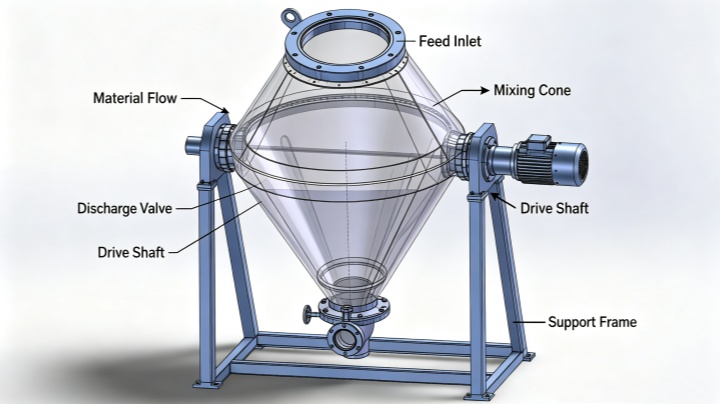
The geometry of the double cone is central to its success. Unlike simple rotating drums, the two conical ends force material to move towards the center, creating strong axial flow that significantly improves cross‑sectional blending. This design ensures that no material remains trapped in a "dead zone," and the gentle, all‑encompassing tumbling action minimizes the risk of segregation by avoiding the air currents and classification forces found in more aggressive mixers.
This makes the double cone mixer an ideal choice for processing delicate or high‑value products where particle integrity is paramount, such as:
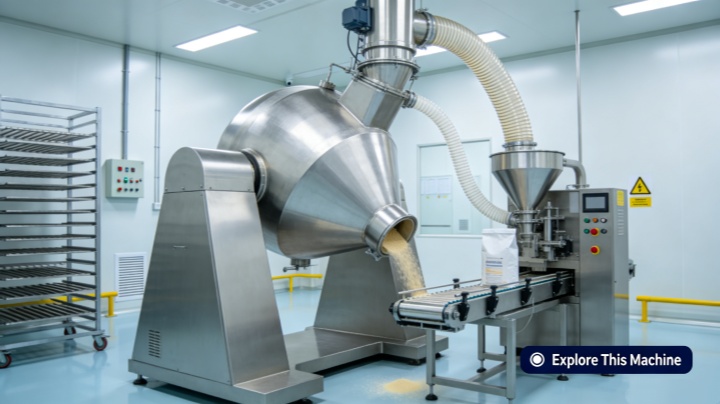
For manufacturers struggling with uneven powder mixing, the double cone rotary mixer presents a proven, reliable, and gentle solution. By harnessing the power of gravity and a strategically designed vessel, it overcomes the fundamental challenges of segregation and particle damage that plague high‑shear methods. If consistent blend uniformity and product integrity are your goals, this technology offers a clear path to process optimization and superior product quality.


Address:China,Yanjin county forest park gate to the west 1000 meters north road.


 Online Chat
 Email
Email