


Unlike commodity powder blending, food additive applications present unique challenges—from handling trace ingredients at ratios as low as 1:8,000 to managing heat‑sensitive enzymes and hygroscopic stabilizers. A ribbon blender designed specifically for food‑grade applications addresses these challenges through forced convection mixing, sanitary construction, and process flexibility.
This guide provides a systematic approach to evaluating and selecting a food additive ribbon blender that matches your production requirements, whether you are formulating nutritional premixes, flavorings, or stabilizers.
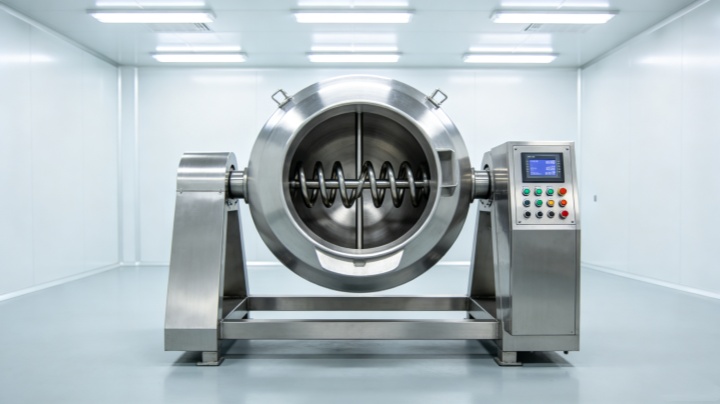
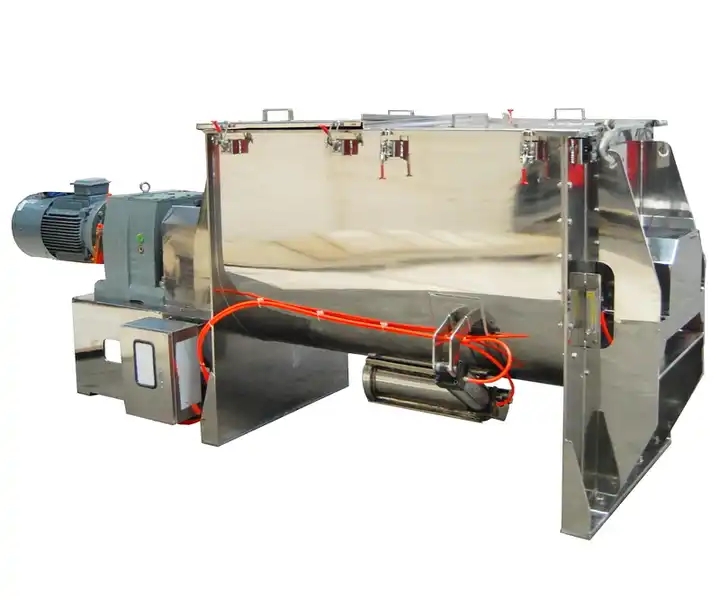
A ribbon blender operates on the principle of convective mixing, which is fundamentally different from the tumbling action of V‑blenders or the diffusion mixing of drum tumblers. Inside a U‑shaped horizontal trough, a central shaft drives two sets of helical ribbons in opposing directions: the inner ribbon moves material toward the ends of the trough while the outer ribbon moves it back toward the center.
This counter‑current flow pattern creates a three‑dimensional mixing action that rapidly homogenizes materials with vastly different properties—dense minerals, lightweight flavor powders, fine starches, and even liquid additives introduced through spray systems. The result is a uniform blend in 5 to 15 minutes, with no dead zones where ingredients can stagnate.
For food additive manufacturers, this mixing principle is particularly valuable because it ensures that micro‑ingredients—such as vitamins, enzymes, or artificial sweeteners—are evenly distributed throughout the batch, eliminating the risk of dosage inconsistency that can lead to product failures or regulatory issues.
Selecting the right blender size involves more than matching batch volume to geometric capacity. Ribbon blenders operate most effectively within a fill range of 60% to 80% of total volume. Overfilling reduces circulation efficiency, while underfilling—below 30% to 40% capacity—prevents the ribbons from properly engaging the product mass, resulting in poor mixing performance.
Start by calculating your target batch weight based on bulk density, then select a blender size that accommodates that weight within the optimal fill range. If you process multiple formulations with varying densities, size around the most demanding product to ensure consistent performance across your product line.
Food additive processing requires equipment that meets stringent hygiene standards. Stainless steel construction—SS304 for general applications or SS316L for highly corrosive or acidic formulations—is essential for product‑contact surfaces. Mirror‑polished interiors with radiused welds prevent bacterial growth and simplify cleaning between batches.
Sanitary features to evaluate include:
The difference in cleanability between a well‑designed sanitary blender and a standard unit can be substantial. One manufacturer reported reducing cleaning time from 60–90 minutes to just 15–30 minutes after upgrading to a properly designed sanitary ribbon blender—a change that enabled faster recipe changeovers and additional batches per shift.
While the standard double‑ribbon agitator works well for most dry powder blends, specific applications may require modifications:
The clearance between ribbons and the trough is another critical factor. Tighter clearances (typically 1/8" to 3/16") reduce residual material and improve mixing efficiency by preventing stagnation in dead zones.
Many food additive formulations require incorporating oils, stabilizers, flavorings, or water into dry powder blends. A built‑in spray system with precision nozzles enables uniform liquid distribution without agglomeration.
When evaluating liquid addition systems, consider:
For applications requiring significant liquid incorporation or heavy paste conditioning, alternative mixer designs may be more appropriate, but for most food additive applications with controlled liquid addition, a properly configured ribbon blender delivers excellent results.
The most reliable drive design for ribbon blenders is a direct‑drive gearmotor, which eliminates the noise, slippage, and maintenance headaches associated with belt‑driven systems. Direct drives are also compatible with variable frequency inverters, providing:
Motor sizing must account for the bulk density of your materials. While standard models typically handle bulk densities up to 35 lbs/ft³, heavy‑duty configurations are available for denser products. Calculate motor load based on the heaviest formulation in your production schedule to avoid underpowering.
A food‑grade ribbon blender supports a wide range of additive applications:
| Application | Typical Materials | Key Requirements |
| Flavorings & Spices | Encapsulated flavors, spice blends, dry powders | Gentle handling to preserve flavor profiles; dust control |
| Stabilizers & Emulsifiers | Hydrocolloids, pectins, starches | Uniform distribution with carriers; liquid addition capability |
| Nutritional Premixes | Vitamins, minerals, enzymes, infant formula ingredients | Trace ingredient homogeneity (ratios as low as 1:8,000); sanitary design |
| Bakery & Confectionery | Cake mixes, dough conditioners, colorants | Batch‑to‑batch consistency; easy changeover for multiple recipes |
For contract manufacturers or facilities producing multiple recipes daily, cleaning time directly impacts throughput. Features that facilitate rapid changeovers include:
Before making a capital investment, request a mixing test from your equipment supplier. Many manufacturers offer sample testing services where you can send 1–2 kg of your most challenging formulation to verify blend quality and cycle times. This risk‑free evaluation confirms that the blender meets your specifications before purchase.
Consider your production growth trajectory when selecting capacity. Oversizing too aggressively can reduce performance on smaller batch runs, while a machine sized only for today's demand may require premature replacement. If your product mix includes multiple SKUs with varying batch sizes, evaluate the blender's performance across your full operating range.
Selecting the right food additive ribbon blender requires a systematic evaluation of your material properties, production requirements, and operational constraints. The ideal machine delivers rapid, homogeneous mixing of trace ingredients, supports sanitary processing with GMP‑compliant construction, and offers the flexibility to handle liquid addition and diverse formulations.
By prioritizing proper sizing, sanitary design, and application‑specific customization, you can invest in a mixing solution that ensures product consistency, regulatory compliance, and operational efficiency for years to come. For detailed technical specifications and capacity options tailored to your production needs, refer to the product page for our Food Additive Ribbon Blender.


Address:China,Yanjin county forest park gate to the west 1000 meters north road.


 Online Chat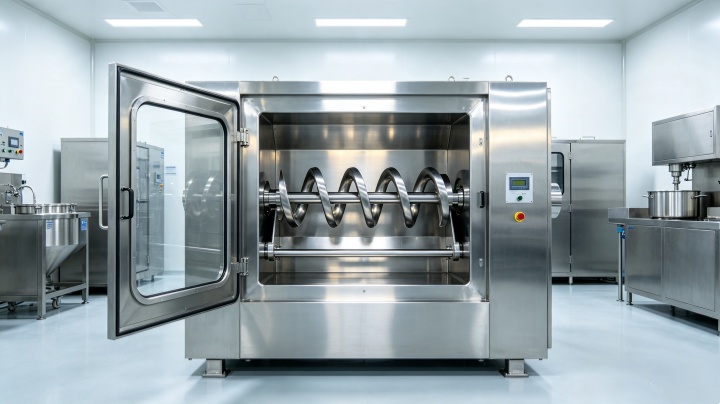
 Email
Email