


When an out‑of‑specification (OOS) result triggers a formal GMP investigation, the cost goes far beyond a delayed shipment. Reprocessing high‑value APIs—some costing hundreds of dollars per gram—quickly becomes a financial headache that no production manager wants to explain.
The frustration is understandable. Both the V‑blender and the double cone blender look like equally viable solutions at first glance. Both are gravity‑driven tumble blenders. Both are built from pharmaceutical‑grade stainless steel. Both are widely used across pharmaceutical, food, and chemical manufacturing facilities.
Yet the difference between them can determine whether your blend hits uniformity targets on the first try—or fails validation and sends you back to the drawing board.
Let's cut through the marketing noise and look at what actually matters: your powder, your facility, and your production reality.
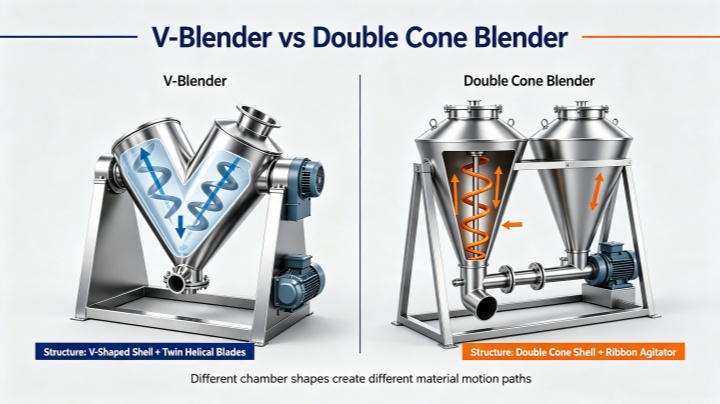
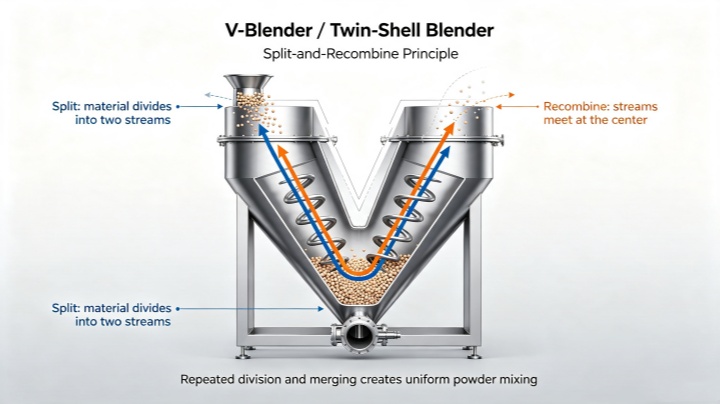
A V‑blender consists of two cylindrical shells joined in a V shape, rotating on a horizontal axis. As the vessel turns, the powder charge splits—half traveling into each arm of the V—then falls back together at the bottom junction. This divide‑and‑recombine cycle repeats with every revolution, generating more blending events per rotation than most other tumble blender designs.
The geometry is the V‑blender's signature advantage. For free‑flowing powders of similar particle size and density, it typically reaches a homogeneous blend faster than a double cone, with excellent uniformity. This is why it remains a workhorse for dry powder premixes, pharmaceutical excipient blends, and food or chemical powders.
Key specs to know:
Optimal fill level: 50–60% of total vessel volume
Rotation speed: Small models run at ~35 RPM, large models (1 tonne) at ~15 RPM
Optional intensifier bar: Available through the shaft for breaking light lumps or dispersing micro‑doses
The double cone blender takes a different approach. The vessel—two cones joined by a short cylindrical section—rotates end‑over‑end on a central axis. Material rolls gently from cone to cone in one continuous, even motion. No asymmetric tumbling. Just a smooth, predictable cycle that handles granules with noticeably more care.
This symmetry creates a distinctive flow pattern. Material at the cone ends experiences a longer path length than material at the cylindrical midsection, producing a differential tumbling effect that promotes cross‑sectional blending.
Key specs to know:
Optimal fill level: 50–70% of total vessel volume
Lower headroom requirement: More compact footprint than a V‑blender
Near‑complete discharge: The cone shape funnels material to a single discharge point, minimizing residue
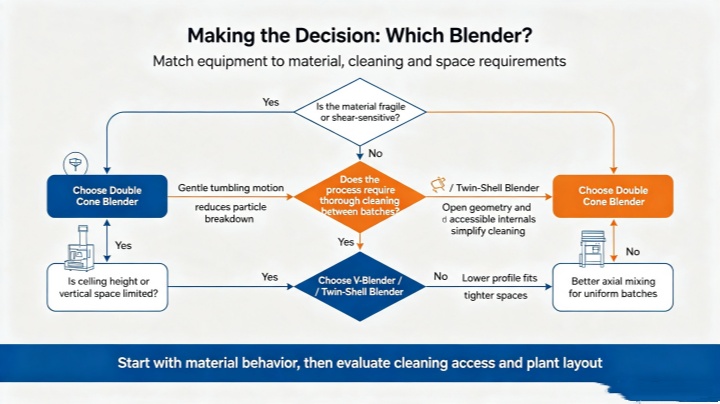
Start with your powder, not the machine. This is the single most important rule in blender selection.
Choose a V‑blender when
Your powders are free‑flowing and have similar particle size and density
You need fast, highly uniform intermixing for pre‑blends or excipient mixes
You have vertical headroom to spare (V‑blenders are taller and require more ceiling clearance)
You're blending fine API powders that carry electrostatic charge or resist uniform distribution—the intensifier bar breaks up agglomerates and drives dispersion
You need to handle cohesive materials with the help of an intensifier bar
Choose a double cone blender when:
You need clean, near‑complete discharge—critical for expensive actives and frequent product changeovers
You're handling fragile granules, crystalline APIs, or coated materials where particle integrity matters
You need a compact footprint with lower height requirements
You run frequent product changeovers that demand fast cleaning and minimal residue
You're blending pre‑formed granules ahead of compression—the gentle rolling motion minimizes particle breakdown
Cohesion problem → V‑Blender with intensifier bar.
Friability concern → Double Cone Blender.
This rule of thumb has held up across decades of pharmaceutical scale‑up data, and it carries real weight when your regulatory submission needs solid process justification.
The V‑blender's asymmetric splitting action tends to produce tighter blend uniformity for fine powders and complex multi‑component API blends, particularly when you're working against demanding RSD (Relative Standard Deviation) targets.
However, the double cone has a meaningful advantage when it comes to segregation risk in multi‑component blends with varying particle sizes or densities. The symmetric rolling motion keeps mixed components together in a way that the V‑blender's splitting action occasionally doesn't, especially during discharge.
Tumble blenders only work well on powders that flow. If your material is strongly cohesive, sticky, or contains a wide spread of particle sizes and densities that segregate under gravity, neither a double cone nor a V‑blender will reliably homogenize it. Gravity alone cannot overcome the cohesion, and an intensifier bar only partly closes the gap.
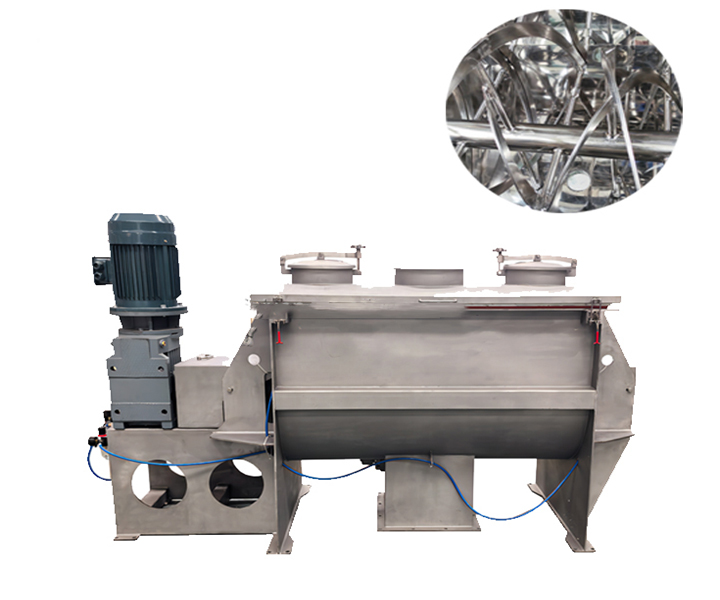
For those materials, you need a forced‑convection design—a horizontal ribbon mixer (the standard fallback) or a ploughshare mixer for tougher cases. The rule of thumb: free‑flowing and shear‑sensitive → tumble blender; cohesive or wide size range → ribbon or ploughshare.
| Feature | Double Cone Blender | V‑Blender |
| Type | Tumble/gravity blender, no agitator | Tumble/gravity blender, no agitator |
| Mixing action | Convergent–divergent fold through cones | Split‑and‑recombine through two shells |
| Shear level | Very low—gentle, minimal attrition | Very low—gentle, minimal attrition |
| Best for | Shear‑sensitive, expensive, changeover‑heavy batches | Fast, very‑uniform blends of free‑flowing powders |
| Discharge/residue | Excellent—near‑total, funnels to a point | Good—from apex valve, slightly more residue |
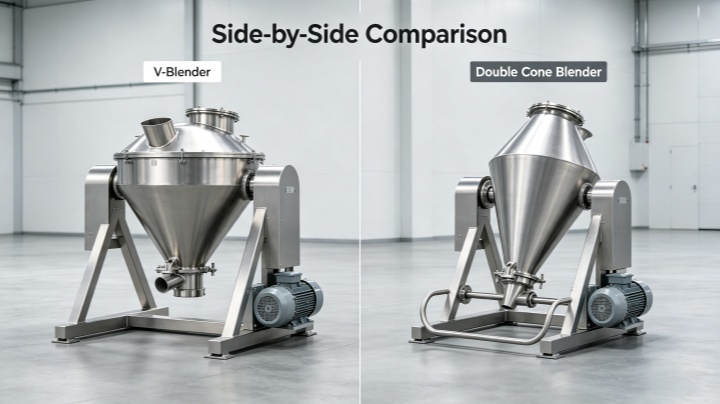
| Footprint | Compact, lower height | Taller, needs vertical headroom |
| Uniformity speed | Good; slower on cohesive powders | Fast and highly uniform on free‑flowing powders |
| GMP/cleaning | SS316L polished, easy to validate | SS316L polished, easy to validate |
| Optional extras | Vacuum‑dry variant available | Intensifier bar for light lumps/micro‑dosing |
A blender that works in a pilot test can still fail on the production floor. The difference is rarely explained by vessel volume alone. Pay attention to:
Batch size range and whether the blender can handle your target throughput
Scale‑up predictability—V‑blenders have decades of published pharmaceutical scale‑up data, which matters for regulatory submissions
Fill level consistency—both designs require careful control; the V‑blender typically runs at 50–60% fill, while the double cone can go slightly higher at 50–70%
Both designs are built from polished SS316L and validate cleanly for GMP. But the double cone's symmetric interior has a subtle advantage: cleaning validation teams quietly appreciate it when it's time to document CIP spray coverage and sign off on protocols.
The absence of internal blades, seals, or bearing surfaces in contact with the blend makes both designs easy to clean and scale up. This is why tumble blenders remain the gold standard for traditional powder blends in regulated industries.
Before committing to either design, ask yourself:
Does your material flow freely under gravity? If not, reconsider.
Are you blending components with similar particle size and density? Wide differences increase segregation risk.
Do you need liquid addition, heating, or vacuum operation? Both designs offer optional configurations, but forced‑convection mixers may handle these tasks more effectively.
For a deeper look at forced‑convection alternatives, our horizontal ribbon mixer and ploughshare mixer pages cover those options in detail.
A specification sheet cannot tell you whether your specific blend will reach uniformity in a cone or a V, how long it will take, or how much residue you'll leave behind. The answer depends on material characterization: particle size distribution, bulk density, shape, cohesiveness, moisture content, and flowability all influence blend behavior.
The safe approach: Run trials with your actual formulation before making a capital commitment. A one‑size‑fits‑all decision often leads to problems that show up in recurring process deviations, long changeovers, difficult sampling, and production schedules that never quite hold.
Our double cone rotary mixer is engineered with AISI 316L contact parts, mirror‑polish finish (Ra ≤ 0.4 µm), and optional configurations including vacuum transfer, liquid binder spray, CIP, and ATEX explosion protection. It delivers blend uniformity with a coefficient of variation (CV) ≤ 5% within 10–20 minutes—comparable to V‑blenders but with a higher effective working capacity and cleaner discharge.
| Your Situation | Recommended Blender |
| Free‑flowing powders, similar size/density, need fast uniform mixing, have vertical headroom | V‑Blender |
| Fragile granules, crystalline APIs, expensive materials, frequent changeovers, compact footprint required | Double Cone Blender |
| Cohesive or sticky powders, wide particle size/density variation | Neither—consider ribbon or ploughshare mixer |
| Fine API powders with cohesion challenges | V‑Blender with intensifier bar |
| Pre‑formed granules for tablet compression | Double Cone Blender |
The bottom line: Start with your powder, not the machine. Both blenders protect shear‑sensitive granules and validate cleanly for GMP. But if you value near‑total discharge, a compact footprint, or you run expensive actives with frequent changeovers, the double cone blender is the stronger fit.
Ready to explore the technical specifications? Our Double Cone Rotary Mixer product page provides complete dimensional data, material certifications, and optional engineering configurations.


Address:China,Yanjin county forest park gate to the west 1000 meters north road.


 Online Chat
 Email
Email