


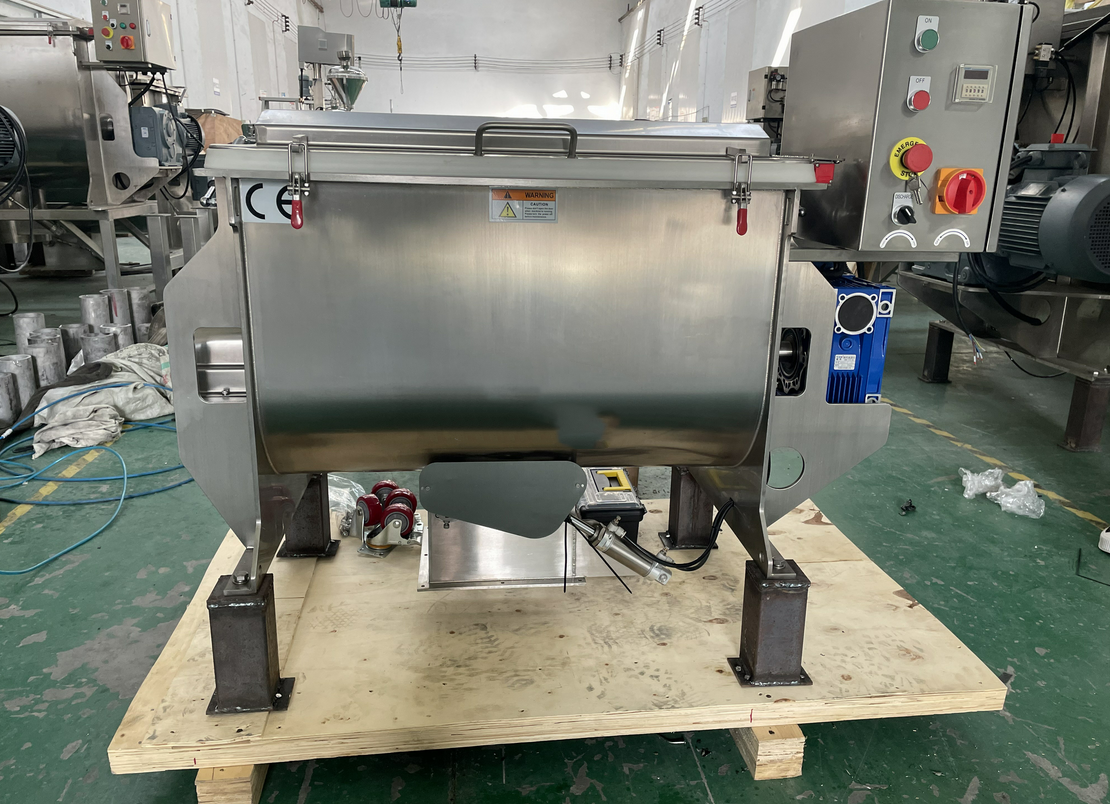
The core criterion for How to Choose Fiber Powder Ribbon Mixer is not price or volume, but the actual flow behavior of the material inside the mixing chamber. The key difference between fiber powders and mineral powders lies in bulk density. When the same equipment handles materials with different bulk densities, the effective batch weight can vary greatly.
The following sections cover four dimensions: material behavior, speed and fill rate, uniformity verification, and power matching.
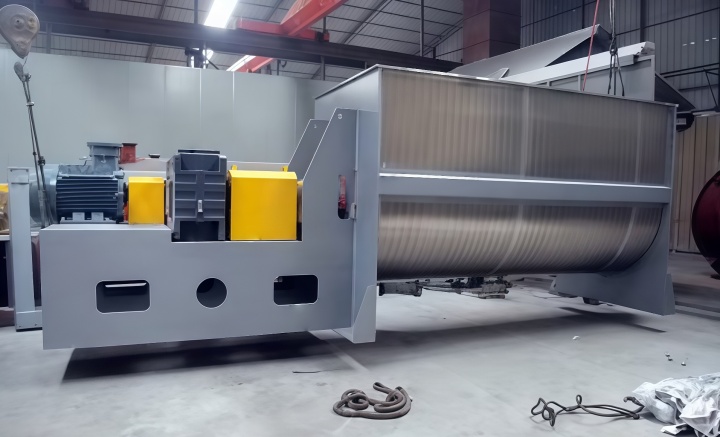
The bulk density of fiber powders typically ranges from 0.25 to 0.5 grams per cubic centimeter. Flour-based powders are about 0.5 to 0.6 grams per cubic centimeter, while cement-based powders reach 1.2 to 1.5 grams per cubic centimeter. Suppose a machine with a total volume of 1.8 cubic meters and a fill rate of sixty percent. When calculated with a material bulk density of 0.9 grams per cubic centimeter, the batch capacity is about 972 kilograms. But when switched to plant fiber with a bulk density of 0.3 grams per cubic centimeter, the actual batch weight at the same fill rate is only 324 kilograms, just one third of the nominal value.
This is an error-prone step in fiber powder selection. Whether a supplier can run a mixing curve with real samples is more informative than a parameter table. For highly hygroscopic fiber powders, the material continuously absorbs ambient moisture during mixing, causing caking and adhesion. In this case, the equipment with vacuum drying function needs to be considered.
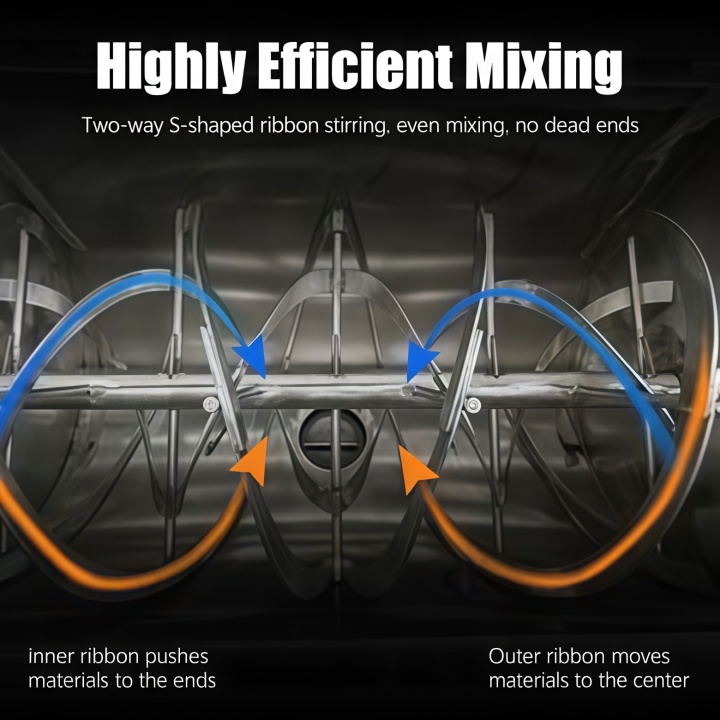
For fill rate, industry technical documents give a reference range of forty to seventy percent of total volume. Below forty percent, the material cannot form an effective circulating flow. Above seventy percent, mixing quality declines within a constant time.
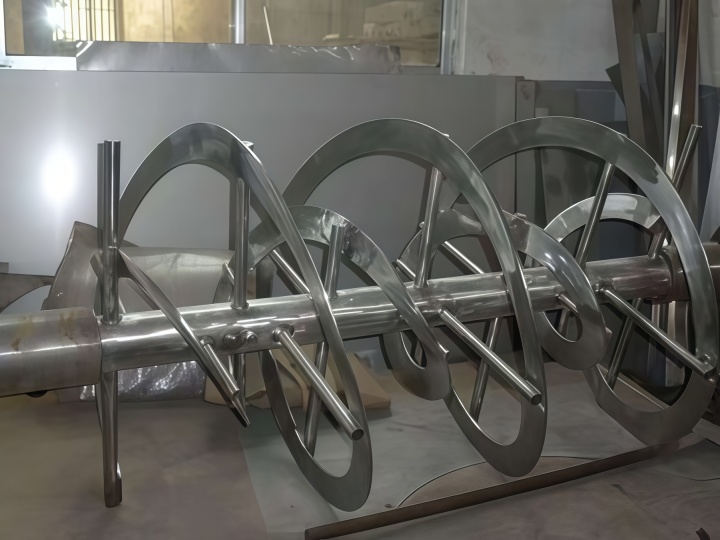
For speed, the design tip speed of ribbon agitators is typically about 300 feet per minute, corresponding to a speed of 20 to 40 revolutions per minute for most industrial equipment. For fiber powders, the speed needs to be lower than that for mineral powder formulations in the same volume, because fiber particles tend to wrap around the mixing shaft or break under excessive shear. Low speed with sufficient circulation cycles is more effective than increasing speed.
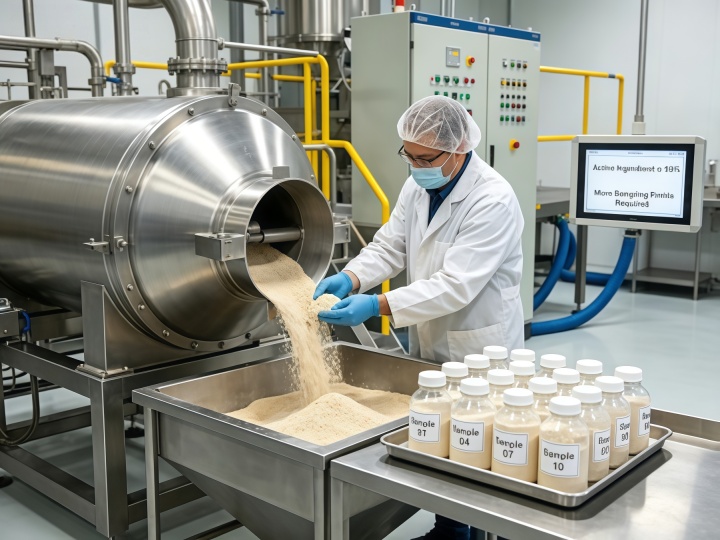
Mixing uniformity cannot be judged by mixing time or appearance alone. The U.S. FDA recommends in its powder mixing validation guidance to sample from 10 locations in the mixing equipment, with 3 samples taken from each location for testing. The guidance issued by the Center for Drug Evaluation of China's National Medical Products Administration also recommends selecting 10 sampling points, with 3 samples taken from each point.
Sampling points should cover both ends of the chamber, the middle, and different stages of the discharge stream. For active ingredients with a content below ten parts per thousand in fiber formulations, the number of sampling points needs to be further increased. The acceptance criterion for mixing uniformity is usually a relative standard deviation not exceeding five percent.
Power matching is closely related to bulk density. Industry data shows that the specific power required per cubic meter of material is typically between 3 and 12 kilowatts. A 1000-kilogram product generally requires a 10 to 15 horsepower motor. Academic research further indicates that mixing torque increases with fill rate and bulk density. When bulk density increases from 0.5 to 1.5 grams per cubic centimeter, the torque load may increase by two to three times.
However, a larger motor is not always better. An oversized motor increases operating costs and may exceed the torque limit of the mixing shaft. A variable frequency drive can achieve soft start under full load, protecting the equipment from startup torque peaks.
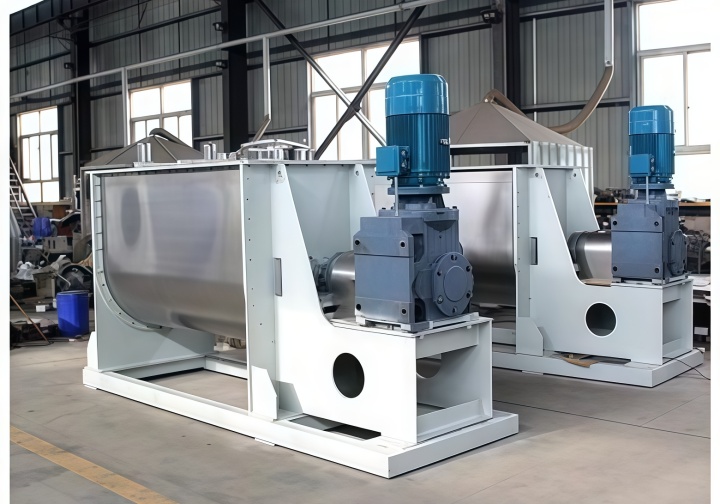
It is recommended to follow the FDA and CDE guidance, selecting 10 sampling points covering both ends of the chamber and the discharge outlet, with 3 samples taken from each point.
Hygroscopic powders absorb ambient moisture, causing caking and wall adhesion. It is advisable to choose a model with vacuum drying function and control the material moisture content before feeding.
An oversized motor increases electricity costs and may exceed the torque limit of the mixing shaft, leading to mechanical failure. Power should be calculated based on bulk density and fill rate.
A flap valve fits the curved surface of the cylinder, leaving less residue, and is suitable for scenarios with high cleaning requirements. A butterfly valve costs less and is suitable for ordinary powders. Fiber powders tend to bridge, so a flap valve is preferred.
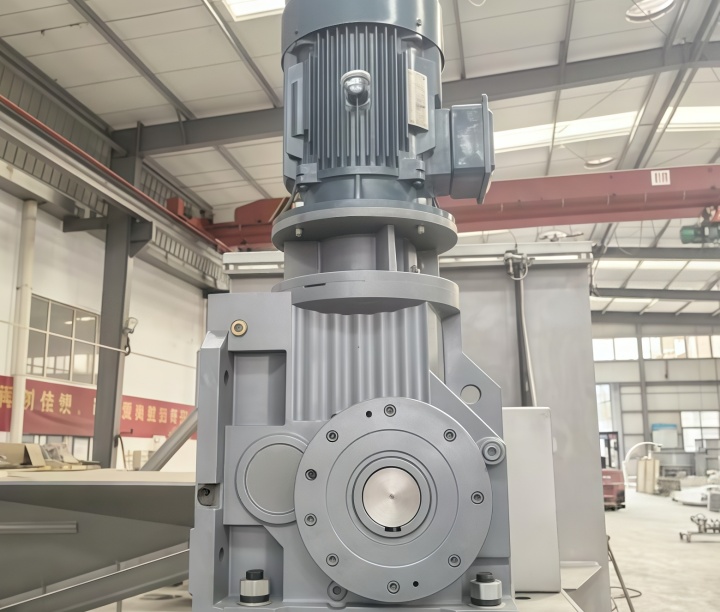
The sequence for choosing a Fiber Powder Ribbon Mixer should start from material bulk density, then balance speed and fill rate, verify uniformity, and then calculate power margin. Skipping the first steps and comparing prices often leads to insufficient batch weight or uneven mixing after production begins.
If you have material samples and batch targets, arrange an actual mixing test first. The judgment obtained will be closer to production reality than a parameter table.


Address:China,Yanjin county forest park gate to the west 1000 meters north road.


 Online Chat
 Email