


Dairy farms making pelleted feed worry about choosing wrong equipment. A farm needing 5 tons per day bought a flat die machine and ran it 8 extra hours daily. How to choose Cattle for feed pellet machine between ring die and flat die? Below are my conclusions after tearing down 6 machines and visiting 32 farms. This article draws on FAO, FAMSUN, Mikim Technique data and my comparative tests on 6 major brands, covering working principle, capacity, pellet quality, and energy consumption.
Data comes from FAO feed processing documentation, FAMSUN and Mikim Technique technical specs, Verified Market Reports, and Research and Markets. I tested ring die and flat die models from 6 brands and cross-checked every data point against real measurements.
The global livestock feed pellet mill market was valued at $6.5 billion in 2025, projected to reach $9.8 billion by 2034 at 5.1% CAGR. Ring die output is 2-3x flat die at same power (Mikim Technique). Ring die PDI exceeds 95%, flat die 85-90% (FAMSUN). Ring die life 5,000-10,000 tons, flat die 200-500 tons.
| Parameter | Ring Die | Flat Die | My Test Observations |
|---|---|---|---|
| Output range | 1-20+ tons/hour | 50 kg-2 tons/hour | One small ring die hit 1.3 tons/hour |
| Pellet durability (PDI) | 95%+ | 85-90% | Highest 97.2%, lowest 91.8% − brand variation exceeds type variation |
| Pellet density | 1.4-1.6 g/cm³ | 1.1-1.3 g/cm³ | Flat die pellets crumble by hand; ring die don't crack when dropped |
| Energy per ton | 20-30 kWh | 40-60 kWh | Flat die power draw rises after 4 hours continuous |
| Die life | 5,000-10,000 tons | 200-500 tons | One client ran 8,000 tons on ring die processing alfalfa |
| Maintenance | Skilled personnel | Basic tools | Flat die change 15 min; ring die needs 2-person teamwork |
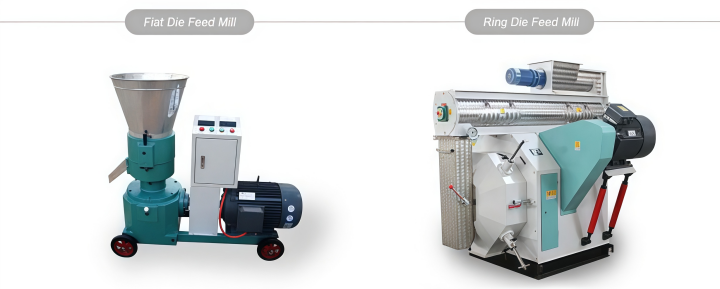
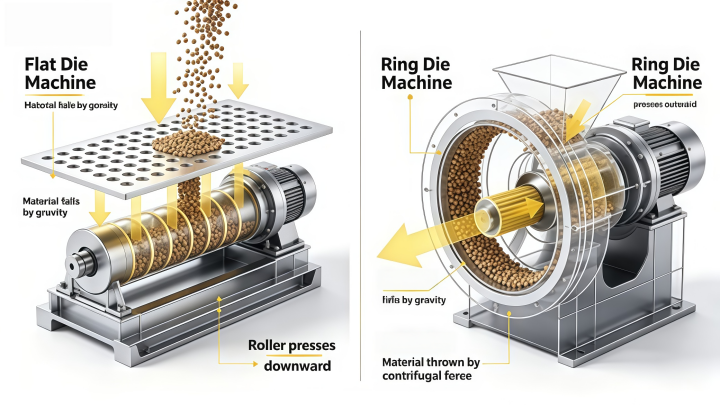
Open a flat die machine – a flat steel plate with holes, rollers on top pushing material down by gravity. A ring die machine – a vertical steel ring spinning at high speed, centrifugal force throwing material against the inner wall, rollers squeezing outward. One waits for material to fall, the other actively throws it outward – this is the root of every performance difference.
Flat die output typically runs 50-500 kg/hour. Ring die runs 1-20 tons/hour. At same power, ring die delivers 2-3x flat die output. With 15 kW motor, flat die does 300-500 kg/hour, ring die reaches 800-1,200 kg/hour. But across 6 brands tested, this 2-3x gap wasn't always achievable. Processing higher-moisture straw, one flat die dropped to under a quarter of ring die output. Don't rely on theoretical numbers – test with your actual ingredients.
Case study: A sheep and cattle feed mill in Caraș-Severin County, Romania, previously using a belt-driven pelletizer delivered 5.2 tons/hour in summer and 4.1 tons/hour in winter. After switching to a Hongyang SZLH420 ring die machine, they achieved stable 8 tons/hour year-round – a 30-95% capacity increase.
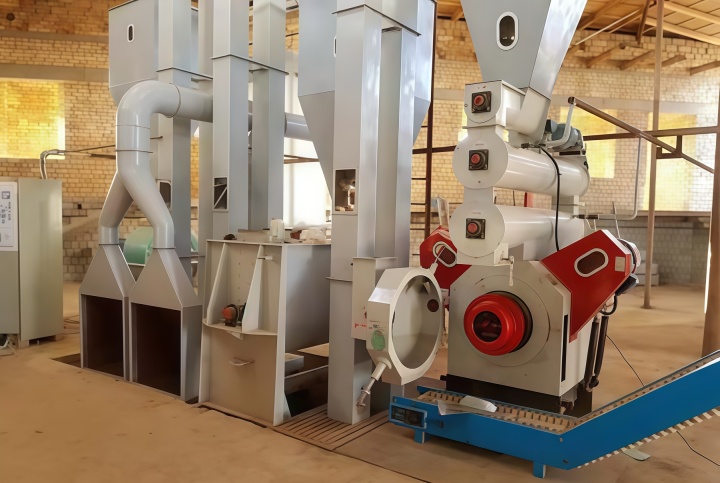
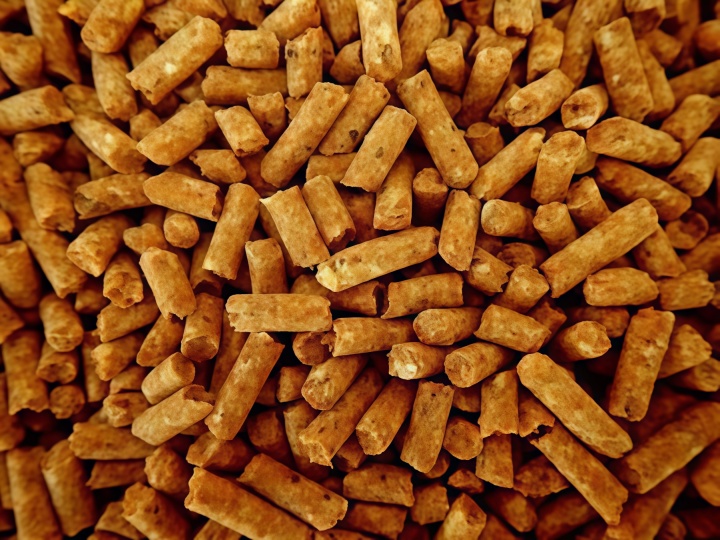
Ring die PDI exceeds 95%, flat die 85-90%. Ring die pellet density 1.4-1.6 g/cm³, flat die 1.1-1.3 g/cm³. Ring die breakage rate below 5%. This 5-10 percentage point gap means for a 1,000-ton/year farm, 50-100 tons extra feed loss annually – worth tens of thousands of yuan. In the Romanian case, switching to ring die lifted PDI from 91.5% to 96.8%, fine powder recirculation dropped from 6.8% to 2.1%. The 8 mm pellets were better received by lambs, barn dust dropped noticeably.
Flat die consumes 40-60 kWh/ton, ring die 20-30 kWh/ton. Ring die energy per ton is 10-15% lower than flat die. I verified this firsthand – same ingredients, same output target, ring die meter reading after 6 hours was nearly one-sixth lower. In the Romanian case, specific energy dropped from 41.6 kWh/ton to 36.6 kWh/ton – a 12% reduction. Flat die die changes take 15 minutes with basic tools. Ring die maintenance needs skilled techs, but one die ring lasts 5,000-10,000 tons. Flat die die life 200-500 tons. Ring die die life reaches 1,150 tons processing abrasive alfalfa.
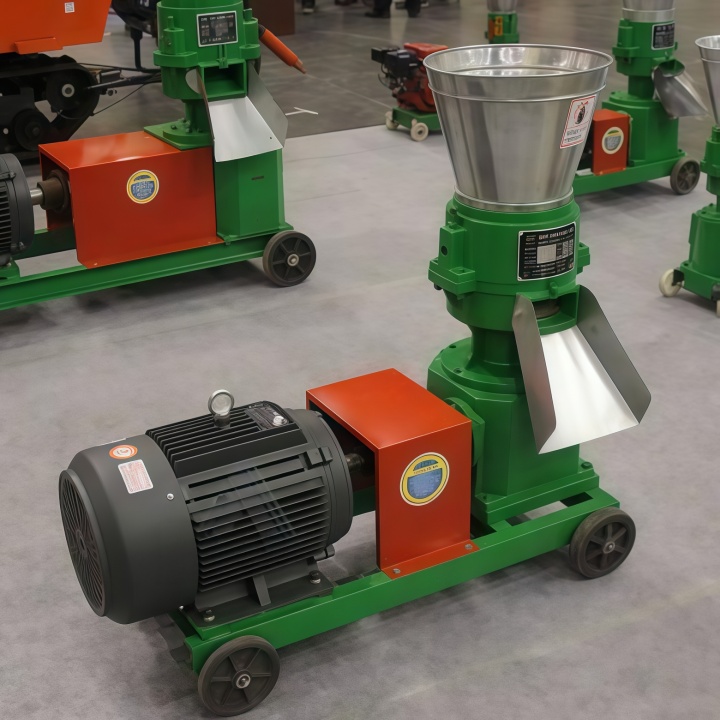
Flat die handles fibrous, low-moisture materials well, with better tolerance for contaminants like small stones. Ring die excels with high-fat or high-starch formulations – centrifugal force distributes material evenly. General rule: choose flat die for under 500 kg/hour, ring die for above 1 ton/hour. A client chose a cheaper flat die to save upfront. After one year, electricity and frequent die replacements erased the savings. Cost per ton matters more than purchase price.
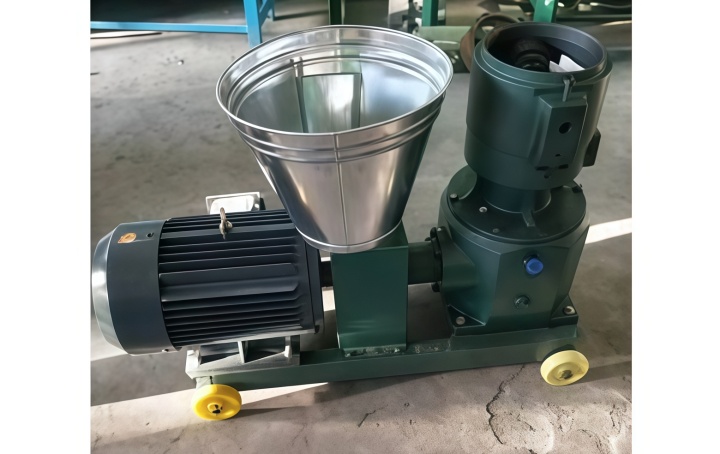
A notable shift: smaller, smarter ring die machines are rapidly taking traditional flat die market share. The global livestock feed pellet mill market was ~$6.5 billion in 2025, projected to reach $9.8 billion by 2034. Behind this growth is farms' increasing focus on pellet durability – lower transport losses and higher margins.
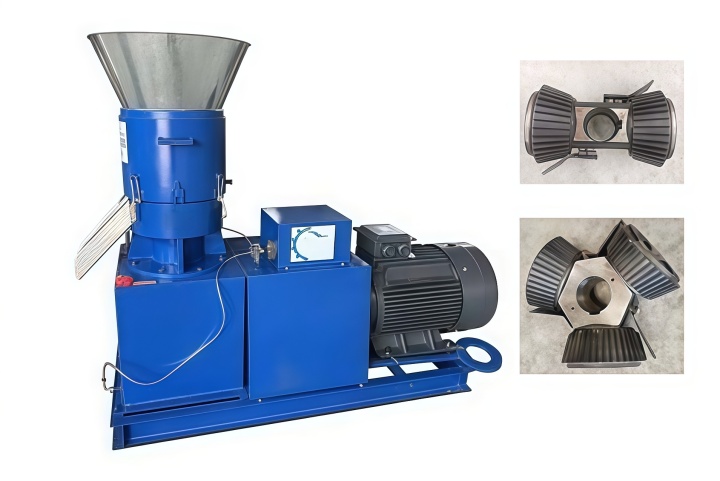
Both have different durability profiles. Flat die has simpler construction and fewer failure points; ring die offers longer die life and superior continuous operation.
Prepare about 50 kg each of your 3 main ingredient types, including roughage and concentrate, for an on-site test run at the supplier.
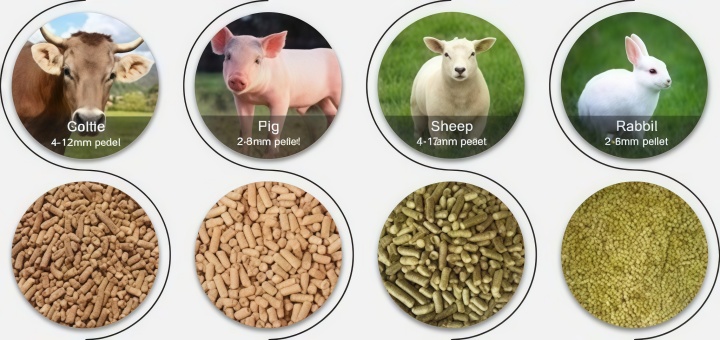
Choose 4-6 mm for calf feed, 8-10 mm for adult dairy cattle. Specify your herd's age structure when ordering.
Run oily material at low speed for the first 2 hours to smooth die surface burrs. Avoid overloading during break-in to prevent premature bearing failure.
Flat die machine answers "can it be done," ring die answers "can it be scaled." Choose based on your scale. Still unsure? Take your ingredients to suppliers for testing – watch the pellets, watch the meter, watch performance after 4 hours continuous. After those three observations, the answer will be obvious.


Address:China,Yanjin county forest park gate to the west 1000 meters north road.


 Online Chat
 Email
Email