


Iron Oxide Ribbon Mixer selection is primarily determined by bulk density. The design bulk density limit for a standard industrial ribbon mixer is approximately 35 lb/cu ft, or about 560 kg/m³.
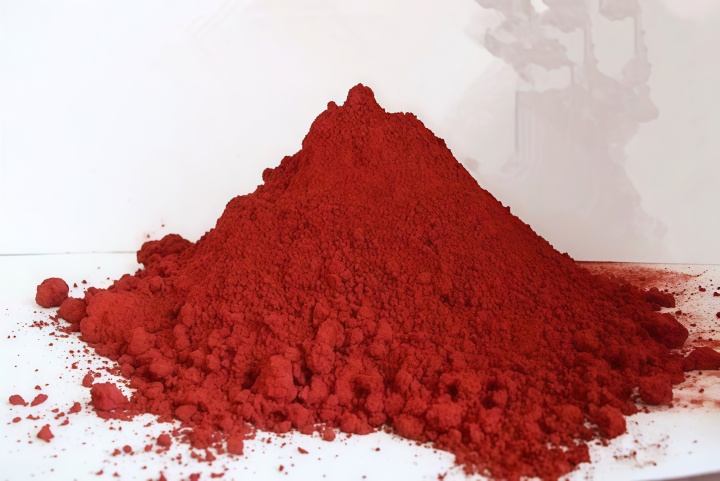
Iron oxide pigments typically have a bulk density between 0.7 and 1.2 g/cm³, corresponding to 700 to 1,200 kg/m³, which exceeds the design capacity of standard models. The true density of iron oxide ranges from 4.8 to 5.24 g/cm³, with moderate to high abrasiveness. Ignoring these numbers means subsequent process adjustments only compensate for selection errors.
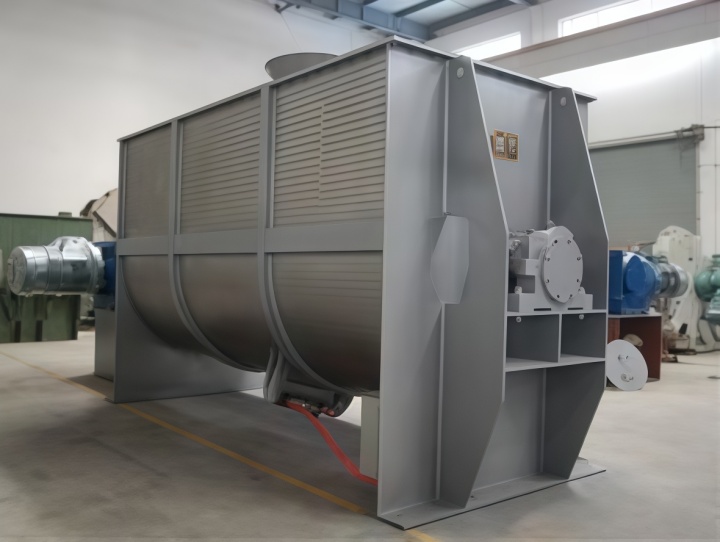
The starting point for selection is not a equipment specification sheet but a specific description of the feed state. Pigment-grade iron oxide coated with surface treatment flows relatively well, while untreated micron-sized iron oxide powder shows noticeable adhesion.
Bulk density is measured according to ISO 787-11, and batch-to-batch variation within the same lot is not uncommon for pigment-grade iron oxide. If the density difference between iron oxide and additives exceeds three times, ordinary convective mixing cannot achieve visual uniformity within fifteen minutes, and extending time only increases abrasion and heat generation.
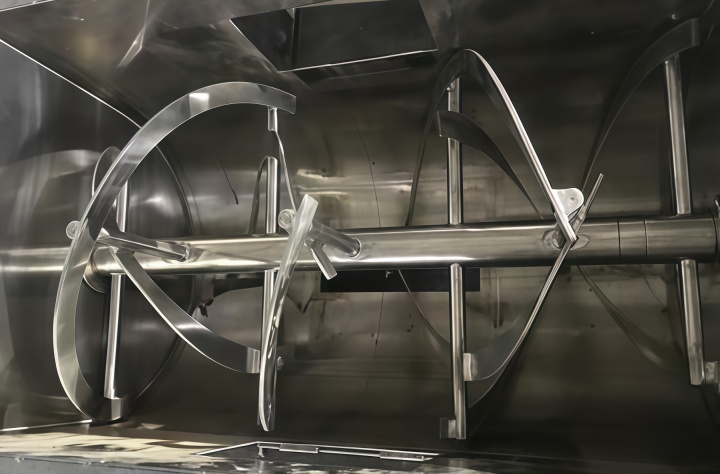
Iron oxide abrasiveness causes much faster wear on internal components than food or pharmaceutical powders. Industry maintenance practice recommends measuring ribbon thickness monthly and replacing when wear exceeds one-third of original thickness; worn parts are rebuilt and hardfaced during annual maintenance.
Ribbons and shafts should use hardened alloy or surface hardfacing. The vessel interior should be fitted with removable wear liners. Drive selection should back-calculate required torque from material density and effective loading volume. Direct-coupled drive is more reliable than belt drive.
Iron oxide fine powder has strong permeability. Air seals or mechanical seals combined with purge gas lines can extend bearing service time. Selection errors often occur as a chain of deviations rather than a single parameter mistake.
Parameter differences across bulk density ranges and grades concentrate in three items: ribbon speed, fill ratio, and contact material. Specific matching is as follows.
| Bulk Density Range | Ribbon Speed Reference | Fill Ratio Reference | Contact Material |
| 0.4 to 0.8 g/cm³ | 18 to 25 rpm | 0.60 to 0.65 | Standard wear configuration |
| 0.8 to 1.2 g/cm³ | 12 to 18 rpm | 0.55 to 0.60 | Hardened ribbon |
| 1.2 to 1.5 g/cm³ | 8 to 12 rpm | 0.50 to 0.55 | Hardfaced plus removable liners |
The above speed and fill ratio ranges combine general industry parameters with field commissioning records from iron oxide production lines. Industry data shows that general fill ratio for ribbon mixers is 0.40 to 0.70 of usable volume, and typical ribbon tip speed is approximately 300 ft/min, or about 91 m/min.
For highly abrasive materials such as iron oxide, maintenance guidelines recommend controlling tip speed between 1.5 and 2.5 m/s to reduce friction intensity. The clearance between ribbon and vessel wall is typically controlled between 4 mm and 10 mm.
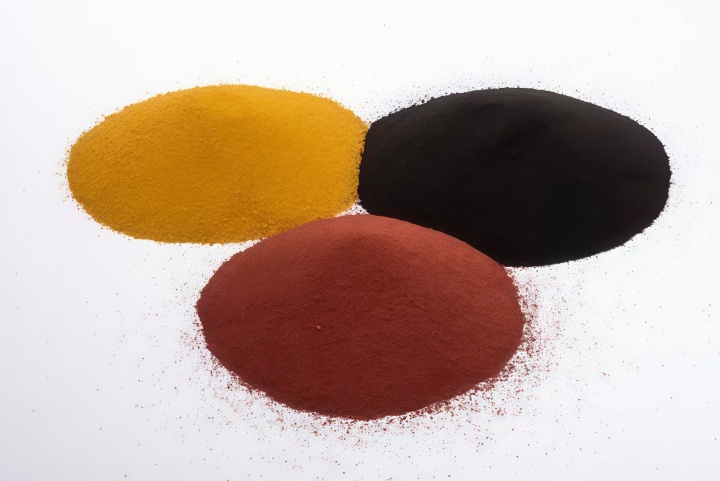
Regarding grade differences, iron oxide black begins to show oxidative color shift toward brown-red at approximately 120°C, and iron oxide yellow dehydrates and shifts toward red above 180°C. Therefore, mixing of black and yellow grades should prioritize temperature control, with ribbon speed taken at the lower end of the reference range. Iron oxide red has relatively higher thermal stability, and selection constraints focus mainly on abrasion control rather than temperature control.
Fill ratio is not recommended to exceed 0.80 of geometric vessel volume. A range of 0.50 to 0.65 provides a balance between efficiency and service time. Verification of uniformity cannot rely on color alone.
Multi-point sampling to determine iron content and calculate relative standard deviation is a traceable quantitative method. Colorimeter measurement of L*a*b* values is used. For iron oxide red pigment, color difference ΔE against a standard sample is typically required to be ≤1.0, and some testing standards accept ΔE≤1.5 as the pass line. Fluorescent tracer method is suitable for routine spot checks, with low cost and fast response.
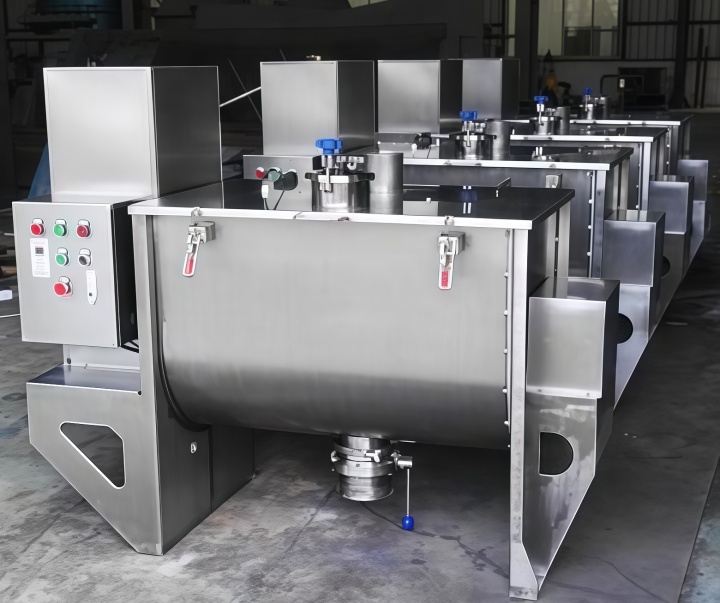
Changeover, wear, grade differences, and residue are four types of questions frequently raised on site. They are answered one by one below.
The problem is likely not mixing time but equipment selection. For materials with density difference exceeding three times, ordinary convective mixing cannot achieve visual uniformity within a reasonable time.
Industry maintenance practice recommends measuring ribbon thickness monthly and replacing when wear exceeds one-third of original thickness. Hardened alloy ribbons with removable liners can extend actual service time.
For pigment grade, black and yellow grades prioritize temperature control and color shift prevention, with ribbon speed taken at the lower end of the reference range. Magnetic material grade iron oxide has higher density and tends to magnetic agglomeration, so fill ratio is slightly lower and sealing level must be increased.
End plate scrapers and flush-type discharge valves can shorten cleaning time. Residual material in vessel dead corners is a major source of color difference in the next batch.
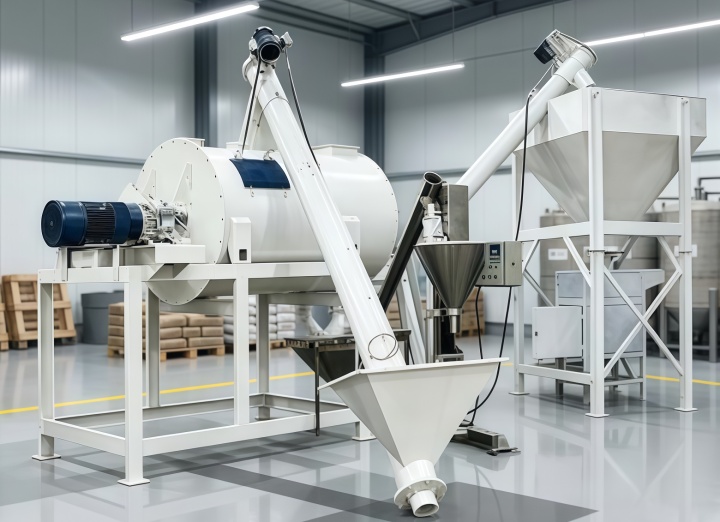
The essence of this mixer selection is matching under constraints. Density, abrasiveness, and thermal stability are hard constraints that cannot be bypassed through operational optimization.
With correct selection, batch consistency, equipment service time, and maintenance costs remain controllable. If you are evaluating a mixing solution for a specific iron oxide grade, providing measured bulk density, particle size distribution, and target batch weight will yield a more suitable configuration recommendation.


Address:China,Yanjin county forest park gate to the west 1000 meters north road.


 Online Chat

 Email