


Iron Oxide Ribbon Mixer is a horizontal ribbon mixing unit designed for the properties of iron oxide powders. It addresses three practical issues: retention and separation of high-density materials, oxidation discoloration of powders, and static charge buildup in dusty environments.
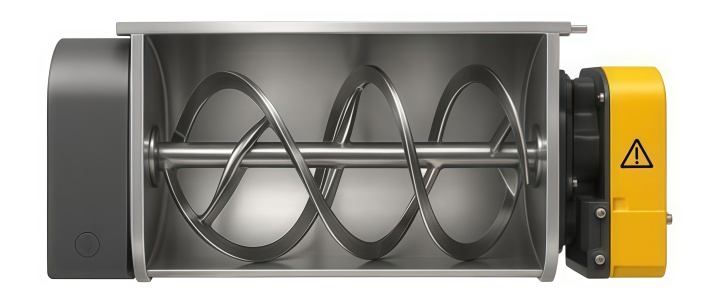
The main body is a horizontal U-shaped cylinder with inner and outer helical ribbon agitators. Product contact parts are made of stainless steel, with 316L available as an option. In actual production, when the mixing uniformity CV of iron oxide red and resin additives exceeds 50 parts per thousand, the hue deviation of the final coating becomes visible to the eye. The unit holds this value at or below 30 parts per thousand.
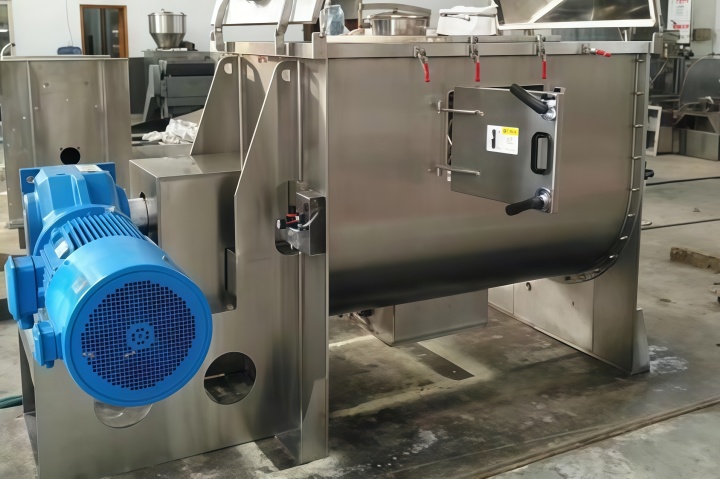
The equipment creates a combined material flow through the opposite pushing action of the inner and outer ribbons. It also completes nitrogen purging before mixing, balancing uniformity and oxidation protection.
A motor drives the main shaft through a reducer. The outer ribbon pushes material from both sides of the cylinder toward the center. The inner ribbon moves center material back toward both sides. This creates axial circulation and radial diffusion. The cylinder has an integrated nitrogen port. Before mixing, oxygen content inside the cylinder is purged to below 0.02 before the main shaft starts.
The bulk density of iron oxide powder usually ranges from 1.2 to 1.8 g/cm³. It is advisable to measure the bulk density of each incoming batch first, then set the batch load by weight. Using the fill factor for ordinary powders can lead to motor overload.
The following parameters are based on measured conditions with iron oxide powder at a bulk density of 1.5 g/cm³. Actual loads for materials of different densities should be adjusted proportionally.
| Model | Total Volume L | Effective Load for Iron Oxide Powder kg | Main Shaft Speed r/min | Motor Power kW | Ribbon-to-Wall Clearance mm | Mixing Uniformity CV | Discharge Residual Rate | Oxygen Content After Nitrogen Purge | No-load Noise dB |
|---|---|---|---|---|---|---|---|---|---|
| IRM-200 | 200 | 180 – 240 | 46 | 4.0 | ≤4 | ≤30 parts per thousand | ≤3 parts per thousand | ≤0.02 | ≤72 |
| IRM-500 | 500 | 450 – 600 | 46 | 7.5 | ≤4 | ≤30 parts per thousand | ≤3 parts per thousand | ≤0.02 | ≤75 |
| IRM-1000 | 1000 | 900 – 1200 | 46 | 11.0 | ≤5 | ≤30 parts per thousand | ≤5 parts per thousand | ≤0.02 | ≤78 |
| IRM-2000 | 2000 | 1800 – 2400 | 46 | 22.0 | ≤5 | ≤30 parts per thousand | ≤5 parts per thousand | ≤0.02 | ≤80 |
Data note: The CV values above are based on measured results from five consecutive batches of iron oxide red and resin additives in the IRM-1000 model, with a mixing time of 8 minutes. Discharge residual rate is the weight of residual material collected by manual cleaning after shutdown as a share of the load. All models include a nitrogen port and an explosion-proof motor selection interface as standard. The seal is a fluoro rubber seal ring and supports positive pressure operation. Product contact parts use 304 stainless steel, with 316L available as an option.
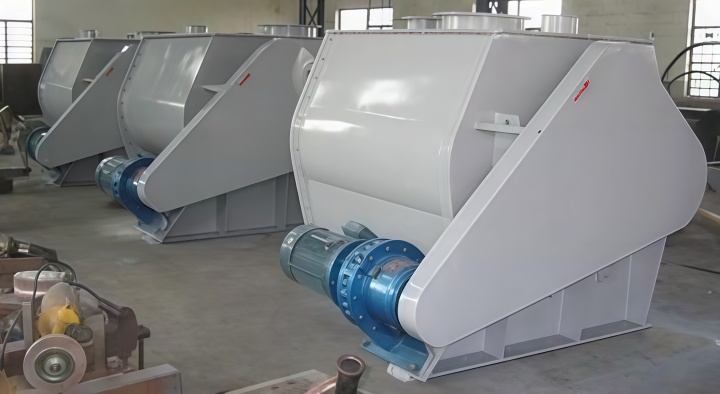
Selection reference:
- IRM-500 suits 450 to 600 kg per batch.
- IRM-1000 suits 900 to 1200 kg per batch.
- IRM-2000 suits 1800 to 2400 kg per batch.
- Keep the actual load at or below half of the effective volume.
The advantages of the equipment in iron oxide powder mixing can be seen in four areas: mixing uniformity, oxidation protection, residual control, and safety performance.
In mixing uniformity, the opposite motion of the inner and outer ribbons brings material to a CV of 30 parts per thousand or lower within 8 to 12 minutes. This shortens the cycle by about two fifths compared with some traditional units that take 15 to 20 minutes.
In oxidation protection, after nitrogen purging the oxygen content inside the cylinder drops below 0.02. In actual operation, the mixing temperature rise stays at or below 3 degrees C, which avoids crystal form changes and hue shift in iron oxides caused by friction heating.
In residual control, the clearance between ribbon and wall is kept within 5 mm. After shutdown, residual material does not exceed 5 parts per thousand of the load. For a 1000 kg batch, this is about 5 kg.
In safety, grounding resistance is less than 4 ohms. The fully enclosed cylinder with a fluoro rubber seal ring can withstand 0.05 MPa positive pressure and fits the safety requirements of dust explosion-proof workshops.
The equipment covers several material types, including pigment-grade iron oxide, ceramic body and glaze, magnetic materials, catalytic materials, powder metallurgy, and friction materials. Each material has different priorities for mixing uniformity and contamination control.
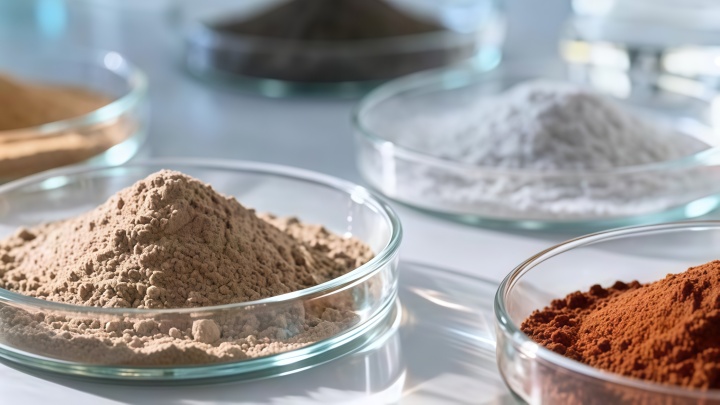
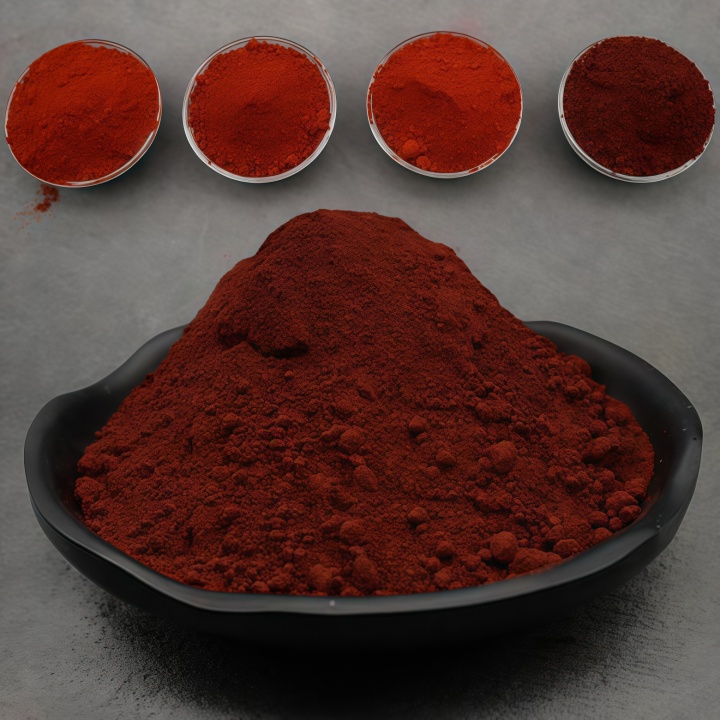
For pigment-grade iron oxide, including iron oxide red, yellow, and black, premixing with resins and additives affects hue stability and tinting strength consistency in the final coating.
For ceramic body and glaze, iron oxide is mixed as a colorant with kaolin, feldspar, and other base materials. Iron contamination must be avoided to protect fired color.
For magnetic materials, iron oxide powder is mixed with strontium, barium, and other raw materials. Uniformity affects magnetic property consistency.
For catalytic materials, iron oxide-based catalyst carriers are mixed with other active components. Low residue and batch-to-batch stability are required.
In powder metallurgy and friction materials, the unit can also be used for premixing iron-based powders with lubricants and alloying elements.
Good operating habits affect mixing results and service cycle in five areas: load control, material addition order, speed adjustment, safe operation, and shutdown handling.
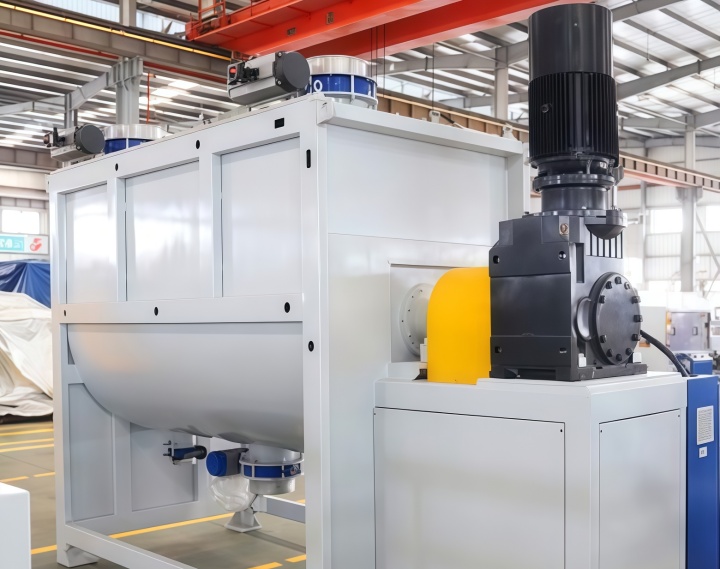
For load control, iron oxide powder has high bulk density. The fill factor should be kept between 0.3 and 0.5 of effective volume, not 0.6 as with ordinary powders.
For material addition order, high-density iron oxide powder should be added first. Liquid additives should be injected through a spray device after dry powders are mixed uniformly.
For speed management, particle size and moisture can differ between batches of iron oxide powder. Adjust main shaft speed based on incoming material test data.
For safe operation, before each start confirm nitrogen purging is complete and oxygen content inside the cylinder is below 0.02. Grounding resistance should be less than 4 ohms. Do not open the cylinder cover during mixing.
For shutdown handling, if power fails or an emergency stop occurs, empty the material inside the cylinder before restarting.
The equipment may encounter five typical problems during operation: abnormal torque rise, lower mixing uniformity, discharge outlet blockage, main shaft speed deviation, and excess residual material in the cylinder. The following troubleshooting paths are organized by fault code.
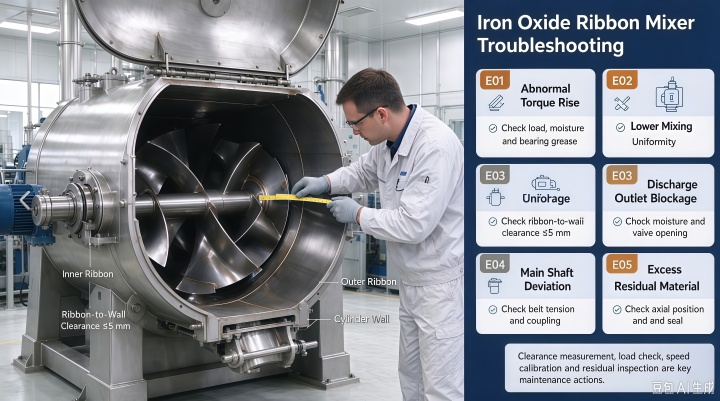
E01 Abnormal torque rise. Start by checking whether the load exceeds half of the effective volume. If the load is normal, check whether moisture has caused lumps larger than 50 mm. Check whether bearing grease has passed its replacement interval. Reduce the load to the recommended range or pre-dry incoming material.
E02 Lower mixing uniformity. Use a feeler gauge to measure the clearance between the outer ribbon and the cylinder wall. If it exceeds the design value of 5 mm, bottom material cannot be turned effectively. Check whether the inner ribbon is deformed and causing an imbalance between inner and outer pushing. Adjust the agitator shaft position or replace the deformed ribbon.
E03 Discharge outlet blockage. Check whether material moisture content exceeds 15 parts per thousand. Confirm whether the discharge valve opening angle reaches the design upper limit. After mixing, idle for 30 seconds before opening the discharge valve to use ribbon pushing force for discharge.
E04 Main shaft speed deviation above 0.05. Use a tachometer to measure actual main shaft speed and compare it with the set value. If deviation is above 0.05, check belt tension or coupling tightness. Calibrate once per quarter.
E05 Excess residual material in the cylinder. Check whether the distance between the ribbon end and the cylinder end plate has increased with operating time. Adjust the axial position of the agitator shaft and replace the end plate seal if needed.
Cut off the main power first. Confirm oxygen content and temperature inside the cylinder are normal before opening the cover. Empty the material before restarting to avoid starting under load and impacting the reducer and motor.
Both outer and inner ribbons can be replaced in sections without fully dismantling the agitator shaft. After replacement, use a feeler gauge to re-measure the clearance between ribbon and wall and keep it within 5 mm.
The floor must support the total weight of the equipment plus the full load. The IRM-2000 has a total loaded weight of about 3.7 tonnes. Install on a level concrete foundation and reserve anchor bolt positions.
Yes. The equipment supports reserved standard signal interfaces, including main shaft speed, motor current, and operating status feedback. Confirm the communication protocol before ordering so it matches the existing workshop control system.


Address:China,Yanjin county forest park gate to the west 1000 meters north road.


 Online Chat


 Email