


Below are the key differences between Fiber Powder Ribbon Mixer vs Paddle Mixer in fiber powder applications. Over the past three years, I have repeatedly encountered the same issue during on-site commissioning of powder mixing equipment: after mixing fiber powder with a Ribbon Mixer, sampling tests often show RSD values above the target at certain points. Troubleshooting usually points to the ribbon blades compacting lightweight fiber against the bottom of the trough. This comparison comes from those actual troubleshooting records.
| Comparison Dimension | Fiber Powder Ribbon Mixer | Paddle Mixer |
|---|---|---|
| Mixing mechanism | Inner and outer ribbon convective circulation | Paddle lifting, turning, tossing |
| Typical energy use | About 3.2 kilowatt-hours per ton | About 4.1 kilowatt-hours per ton |
| Fill rate range | 0.6 to 0.75 is suitable | 0.25 to full fill is acceptable |
| Action on fiber agglomerates | Local breakage, uneven | Tumbling release, no compaction |
| Cleaning difficulty | Ribbon gaps tend to hold residue | Open paddle structure, less residue |
| Suitable applications | Free-flowing dry powder, large batch mixing | Fragile materials, high fiber, liquid addition |
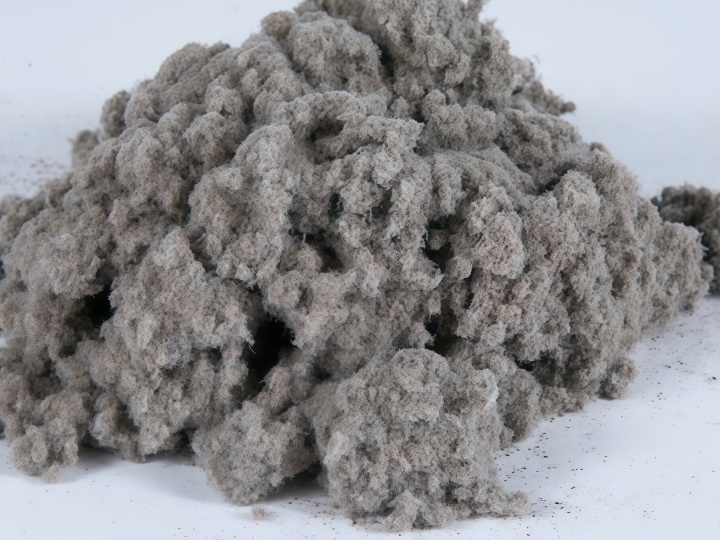
Fiber powder mixing has an easily overlooked problem: low bulk density and rough particle surfaces make false agglomeration common during mixing. The color may look uniform, but sampling tests repeatedly show content deviations.
Fiber Powder Ribbon Mixer vs Paddle Mixer can both handle dry powder mixing, but their performance differences in fiber powder applications often become apparent only after production starts.
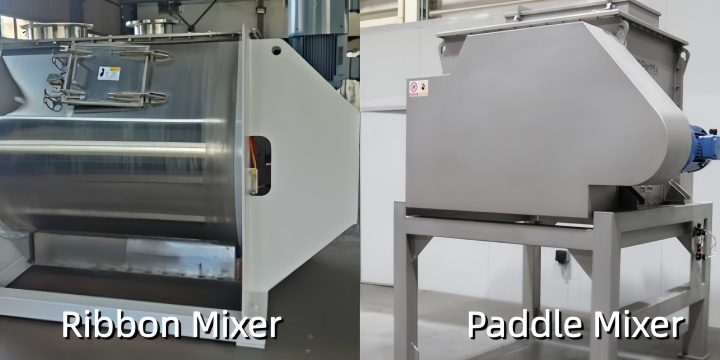
Three sets of data come from public industry test reports and equipment manufacturer technical documents. Test conditions: wood fiber and mineral powder blend, bulk density 0.18 to 0.25 grams per cubic centimeter, fill rate 0.55, 5 to 10 sampling points per batch.
| Measured Item | Fiber Powder Ribbon Mixer | Paddle Mixer | Data Source |
|---|---|---|---|
| Typical batch time for dry powder mixing | 10 to 20 minutes | 30 to 120 seconds | Industry test report |
| Mixing uniformity CV | CV ≤ 0.05 | CV ≤ 0.03 | Equipment manufacturer technical document |
| Equipment gap and residue | Ribbon-to-trough gap 1/8 to 3/16 inch, residue easily accumulates in gaps | Open paddle structure, good internal access, less residue | Industry technical literature |
| Adaptability to fiber mass fraction above 0.3 | Low-density fiber tends to compact at the bottom, lower content at upper sampling points | Prevents fiber clumping, CV can remain stable within 0.04 | Industry application data |
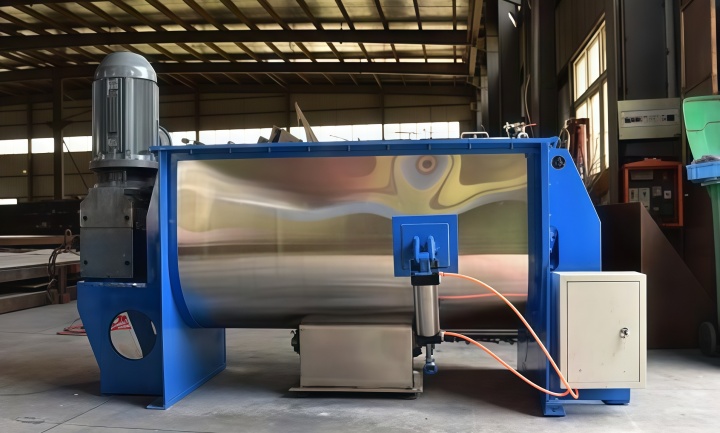
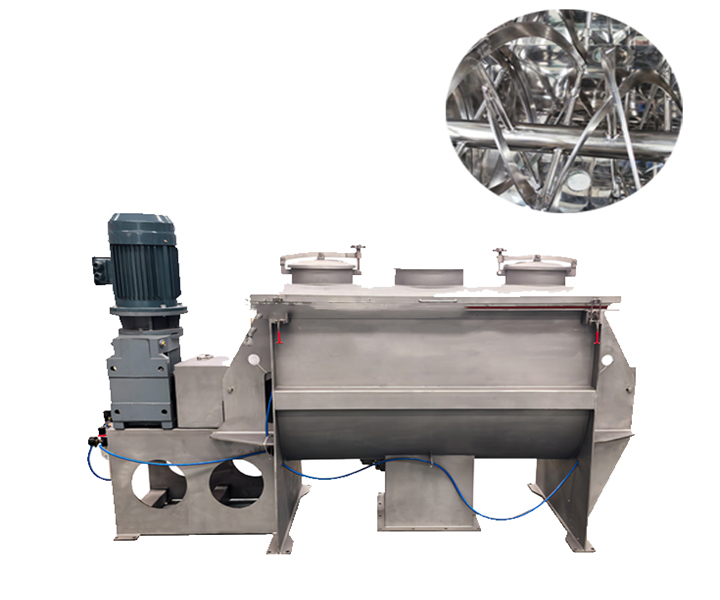
Fiber Powder Ribbon Mixer uses a double ribbon inside a U-shaped trough. The outer ribbon pushes material from both ends toward the middle, while the inner ribbon pushes from the middle toward both ends, creating a convective folding action. This design is efficient for free-flowing dry powders, but fiber powder bulk density is often 0.15 to 0.4 grams per cubic centimeter. The axial force of the ribbon tends to compact low-density fiber against the trough bottom.
Near the ribbon zone, over-mixing occurs, while the fiber in the upper layer has a compressed circulation path. As a result, fiber content varies noticeably among sampling points within a batch. Industry literature also notes that for low-density materials or formulas with large component differences, standard ribbon action may not provide sufficient mixing control.
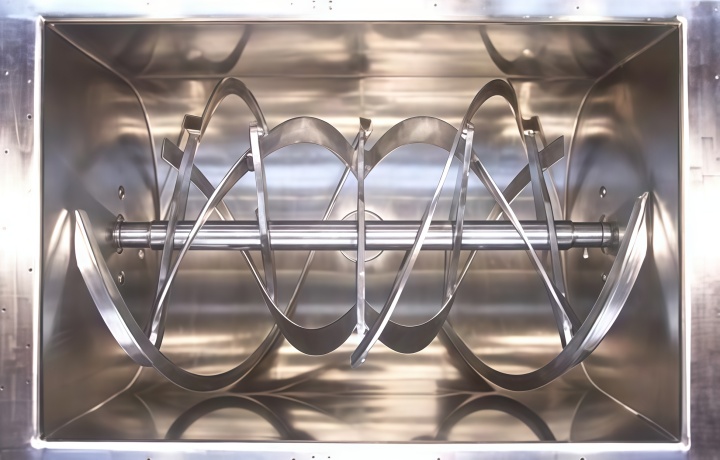
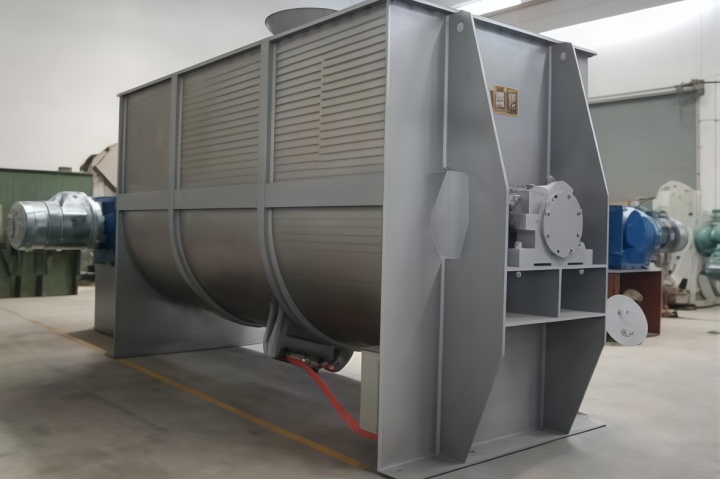
Paddle Mixer uses angled paddles on a shaft to lift, turn, and toss material. The material forms a three-dimensional tumbling motion inside the trough. Relative displacement between particles relies mainly on gravity rather than mechanical push. Fiber powder is less likely to be pressed into dense blocks, and agglomerates have a chance to break apart during tumbling. The fill rate tolerance is wide; a lower limit of 0.25 fill can still run.
Industry application data shows that a twin-shaft paddle mixer processing material with fiber content of 0.3 can maintain CV within 0.04. In the feed ingredient sector, for high-fiber formulas with crude fiber content above 0.15, a horizontal paddle mixer is recommended as a preferred option, with mixing uniformity CV controlled within 0.04.
When choosing between the two, three dimensions matter more than mixing uniformity itself: agglomeration tendency, bulk density span, and cleaning convenience.
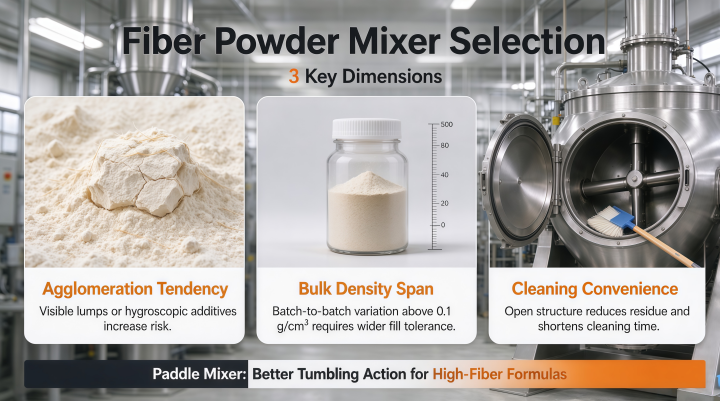
Agglomeration tendency. If fiber powder already has visible lumps at feeding, or the formula contains hygroscopic additives, the low-shear tumbling action of Paddle Mixer makes it harder for agglomerates to hide in the material flow.
A real case from the spice industry: a spice manufacturer spent three months troubleshooting batch consistency problems. All raw material specs passed, but the issue was eventually traced to a Ribbon Mixer that did not match a formula containing hygroscopic binders. After switching to a Paddle Mixer, the initial trial run solved the problem.
Bulk density span. The same fiber powder formula can vary in bulk density from batch to batch. Ribbon Mixer has a suitable fill rate of 0.6 to 0.75; Paddle Mixer can maintain acceptable mixing variation across a fill range of 0.25 to full.
Cleaning convenience. The gap between the outer ribbon and the trough in a Ribbon Mixer is 1/8 to 3/16 inch. Fiber powder easily forms a compacted residue layer there. Dead zones may also exist near the discharge valve, requiring extra recovery of material from that area. Paddle Mixer has a relatively open paddle structure, better internal access, and less residual material.
If fiber powder is a low proportion of the formula, and the main materials are free-flowing mineral powder, sugar powder, or starch, with large batch sizes, the fast convective circulation of Fiber Powder Ribbon Mixer still offers advantages in energy use and efficiency.
In dry powder mixing for the spice industry, Ribbon Blender energy use is about 3.2 kilowatt-hours per ton, while Paddle Blender is about 4.1 kilowatt-hours per ton. When a small amount of liquid binder needs to be sprayed in, the ribbon can also provide a more even liquid dispersion path, provided the liquid addition is controlled properly.
Its value lies in fast homogenization of large batches, low fiber load, and free-flowing systems, not in high-fiber formulas.
The spice manufacturer case above is worth expanding. The factory’s masala mix production line had batch consistency problems for three consecutive months. Every sieving analysis and raw material inspection passed, but customer complaints remained high.
Investigation showed the formula contained a hygroscopic binder. The ribbon blades compacted the binder and light spice powder into lumps during mixing. These lumps were hard to find during sampling but gradually appeared downstream in filling and storage.
After switching to Paddle Mixer, under the same formula and fill rate, the initial trial run met the acceptance standard, and later batches did not show the same consistency problem. This case shows that energy parameters cannot replace material suitability judgment.
Paddle Mixer runs at low speed with weak shear, so temperature rise is usually lower. Fiber Powder Ribbon Mixer has continuous ribbon pushing, so local temperature rise is more noticeable for heat-sensitive fibers during extended mixing.
Both depend on seal design, not just machine type. Paddle Mixer usually runs at lower shaft speed, so fine powder intrusion risk is relatively small, but poor maintenance can still cause failure.
Both must be grounded. Paddle Mixer tossing and tumbling can more easily raise fiber dust, making static risk more prominent. Fiber Powder Ribbon Mixer produces less dust, but local compaction may accumulate static charge.
Paddle Mixer runs at low speed with small impact, so noise and vibration are usually lower. Fiber Powder Ribbon Mixer under full load has larger load fluctuations, making vibration and noise more noticeable.
It depends on fiber content and fill rate. Paddle Mixer can reach uniform mixing in 30 to 120 seconds for dry powder and granular materials. Ribbon Mixer typically needs 10 to 20 minutes for standard dry powder.
The dry powder mixing industry often uses CV ≤ 0.05 as an acceptance line. Paddle Mixer can reach CV ≤ 0.03 in many applications, while Ribbon Mixer is usually around CV ≤ 0.05.
The five steps go from fiber proportion, bulk density, feed state, and cleaning frequency to the combined judgment of output and fiber load. They narrow the selection range step by step and land on the suitability boundary between Ribbon Mixer and Paddle Mixer.
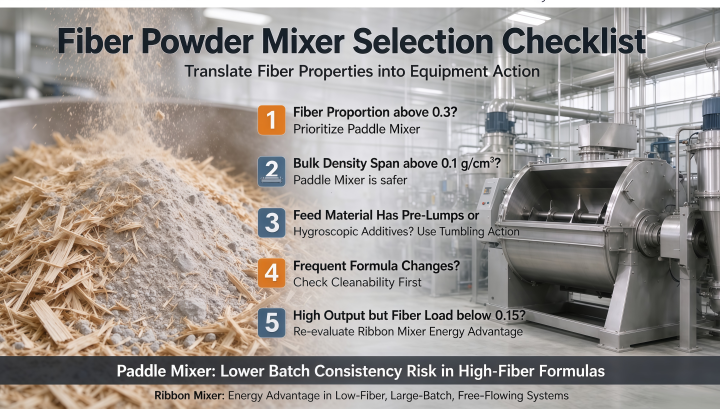
Step one: Confirm the mass proportion of fiber powder in the formula. If it is above 0.3, consider Paddle Mixer as a priority.
Step two: Check the bulk density range of the fiber powder. If batch-to-batch variation is above 0.1 grams per cubic centimeter, the fill rate adaptability of Paddle Mixer is safer.
Step three: Evaluate feed state. If the fiber material has pre-lumps or the formula contains hygroscopic additives, the tumbling action of Paddle Mixer makes it harder for agglomerates to remain.
Step four: Check cleaning frequency. If formula changes are frequent, the open structure of Paddle Mixer can shorten the cleaning window.
Step five: If the above conditions all point to Paddle Mixer, but output requirements are high and fiber load is below 0.15, you can re-evaluate the energy advantage of Fiber Powder Ribbon Mixer.
Choosing between Fiber Powder Ribbon Mixer vs Paddle Mixer is essentially translating three properties of fiber powder—low density, tendency to tangle, and shear sensitivity—into the language of equipment action.
Paddle Mixer shows fewer batch consistency risks in many high-fiber formulas. Fiber Powder Ribbon Mixer retains an energy advantage in low-fiber load, large batch, free-flowing systems.Test with the formula that has the higher fiber content first. If Paddle Mixer can keep CV stable within 0.04 at 0.3 fiber load, you have a basis for adding more fiber.


Address:China,Yanjin county forest park gate to the west 1000 meters north road.


 Online Chat


 Email