


Fiber Powder Ribbon Mixer is a horizontal ribbon-type blending machine designed specifically for fiber powders such as glass fiber, carbon fiber, and cellulose fiber. It uses a low-shear folding-and-tumbling motion to achieve mixing uniformity CV ≤ 5% while maintaining fiber length retention ≥ 95%. It is designed to solve common fiber powder problems including agglomeration, tangling, and fiber breakage. The machine supports non-standard customization for capacity, material characteristics, and production conditions. Contact parts and frame can be 304/316L stainless steel or carbon steel. It can also be integrated with feeding, packaging, and conveyor lines for continuous automated production.

The Fiber Powder Ribbon Mixer combines mixing efficiency, mixing quality, and practicality. Firstly, it employs a unique ribbon structure design, resulting in a gentle, non-shearing mixing process that maximizes fiber length and integrity, preventing fiber breakage and clumping. The mixing uniformity far surpasses ordinary mixing equipment, with no layering, dead zones, or residue.The ribbon agitator operates at low shear rates, typically below 50 RPM for fiber applications. Unlike paddle or plough mixers that rely on high-speed impact, the forward and reverse spiral ribbons create a folding-and-tumbling motion that preserves fiber integrity. This design achieves CV ≤ 5% and avoids layering, dead zones, and residue. Secondly, the equipment operates stably with lower energy consumption and moderate stirring force, suitable for viscous, lightweight, and fluffy fiber powders. It supports full-process non-standard customization, adapting to special working conditions and material requirements. With various additional functions to enhance automation, it improves production efficiency, ensures product quality stability, and reduces material loss and labor costs.

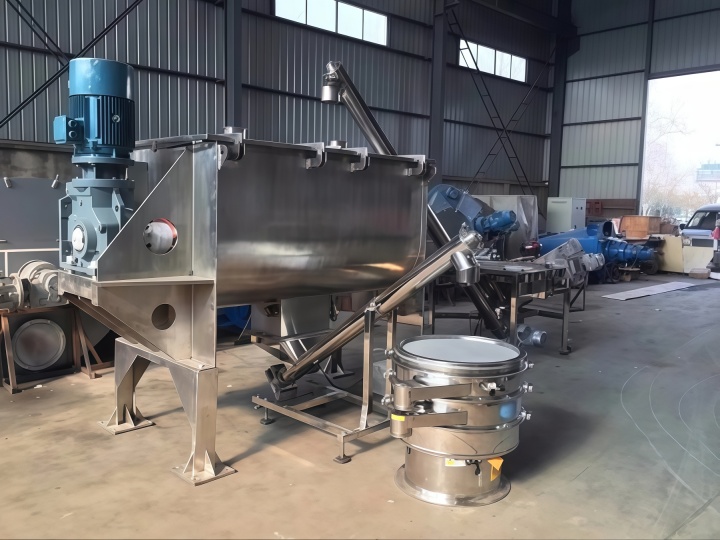
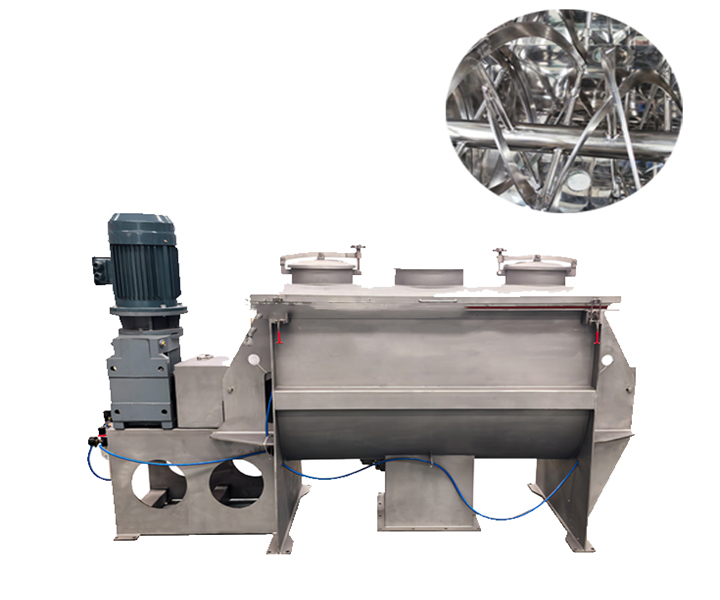
The Fiber Powder Ribbon Mixer has a compact and rational overall structure. Its core consists of a mixing cylinder, a double-layer ribbon mixing assembly, a drive motor, a reducer, a discharge device, and a frame. The structural design is tailored to the flow characteristics of fiber powder. The mixing cylinder is primarily a U-shaped horizontal structure with a smooth, burr-free inner wall, reducing fiber residue. The stirring ribbon employs a forward and reverse spiral design, with calculated pitch and gap to fit snugly against the inner wall of the cylinder, ensuring all-around material agitation.For fiber applications, ribbon clearance is typically 3–8 mm depending on fiber type and length. Glass fiber often uses 5–8 mm, carbon fiber 3–5 mm, and cellulose fiber 8–12 mm. Actual clearance should be confirmed with material testing. The drive assembly features a high-quality motor and reducer, providing stable power output and adjustable speed. The overall structure is robust and durable, easy to disassemble and assemble, facilitating daily cleaning, maintenance, and ribbon replacement.

The Fiber Powder Ribbon Mixer achieves three-dimensional mixing of materials through the directional rotation of the ribbon. After startup, the motor drives the reducer to rotate the ribbon spindle at a uniform speed. The inner and outer ribbons create opposing pushing forces. The outer ribbon pushes the fiber powder from the periphery of the cylinder wall along the axis towards the center, while the inner ribbon transports the central material to both ends of the cylinder. Simultaneously, the circumferential agitation creates a complex motion of convection circulation and shear diffusion within the cylinder. The material comes into contact with the surrounding material during this circulation, completing batch mixing in a short time.
| Model | LHY-0.25 | LHY-0.5 | LHY-1 | LHY-1.5 | LHY-2 | LHY-3 | LHY-4 | LHY-6 | LHY-8 | LHY-10 |
| One-time mixing (kg) | 100-150 | 200-300 | 400-600 | 600-900 | 800-1000 | 1200-1800 | 1600-2400 | 2400-3600 | 3200-4800 | 4000-6000 |
| Mixing time (min) | 8-20 | 8-20 | 8-20 | 8-20 | 8-20 | 8-20 | 8-20 | 8-20 | 8-20 | 8-20 |
| Mixing speed (r/min) | 60 | 55 | 45 | 40 | 35 | 25 | 25 | 20 | 15 | 15 |
| Motor power (kw) | 3-5.5 | 4-11 | 7.5-15 | 11-18.5 | 15-22 | 18.5-30 | 22-37 | 37-55 | 37-55 | 45-75 |
| Weight (kg) | 500 | 900 | 1800 | 2500 | 3200 | 4100 | 5100 | 6300 | 7500 | 9500 |
Fiber Type Recommended Parameters
| Fiber Type | Ribbon Clearance | Recommended RPM | Typical Mixing Time | Fiber Length Retention |
| Glass Fiber | 5–8 mm | 25–35 | 8–12 min | ≥95% |
| Carbon Fiber | 3–5 mm | 20–30 | 10–15 min | ≥97% |
| Cellulose Fiber | 8–12 mm | 30–40 | 6–10 min | ≥92% |
Note: The speeds in the main specification table are maximum mechanical speeds. For fiber powders, actual operating speed is often reduced to 15–40 RPM depending on fiber length and fragility.
Our factory produces two types of Fiber Powder Ribbon Mixers: horizontal and vertical. Customers can choose the type that best suits their production needs and application scenarios, ensuring adaptability to fiber powder mixing in various situations.

Horizontal Fiber Powder Ribbon Mixer: This machine features a legless design, with the entire body directly fixed to the ground or a supporting platform via a base. The horizontal layout of the cylinder results in a low center of gravity, extremely high operational stability, a long mixing stroke, and higher mixing uniformity. It is suitable for large-scale, continuous industrial production, especially for mixing long fibers and high-bulk powders.For long glass fiber or high-bulk powders, horizontal models are usually recommended to reduce fiber breakage.
Vertical Fiber Powder Ribbon Mixer: Equipped with dedicated support legs, the cylinder has a vertical layout, supporting the main unit and leaving space for discharge below. It has a small overall footprint, making it suitable for small workshops with limited space, small-batch, multi-batch production scenarios, or laboratory research and development, and pilot-scale testing. It offers fast discharge speed and thorough discharge, facilitating manual loading or docking with small feeding machines. The roller design allows for easy movement in different production environments.
The Fiber Powder Ribbon Mixer covers multiple production fields involving fiber powder mixing. In the chemical industry, it can be used to mix glass fiber, carbon fiber, and cellulose fiber powders with resin powders, fillers, and additives to produce composite materials, friction materials, and sealing materials. In the building materials industry, it is suitable for blending fiber powders with cement, sand, and additives in thermal insulation mortars, putty powders, and self-leveling materials to improve the toughness of building materials. In the pharmaceutical industry, it is suitable for low-damage mixing of pharmaceutical fiber excipients and active pharmaceutical ingredient powders to meet the cleanliness requirements of pharmaceutical production. In addition, it can also be used in industries such as feed and rubber and plastic modification for mixing various plant fiber, chemical fiber, and mineral fiber powders.For example, in one friction material application, a 2,000 L horizontal model mixed glass fiber and resin powder with CV ≤ 5% in 10 minutes.

The Fiber Powder Ribbon Mixer can comprehensively optimize the user experience for the special process requirements of fiber powder mixing. It can be flexibly configured as needed to further broaden the applicable scenarios, improve production efficiency and mixing quality, and adapt to various customized production conditions.

Spray Design: An optional dedicated spray design is available, featuring built-in atomizing spray pipes and nozzles installed on the upper part of the mixing cylinder. This allows for the simultaneous and uniform spraying of liquid additives, binders, wetting agents, and other materials during the material mixing process, achieving synchronous mixing and coating of powder and liquid.
Roller Design: Primarily designed for small horizontal and vertical mixers, silent and wear-resistant universal rollers are installed at the bottom of the equipment base or support legs. Some rollers have a self-locking function, ensuring stability during equipment operation while facilitating flexible movement. Suitable for multi-workshop rotation, small-batch material change production, or frequent equipment relocation in laboratories.
Discharge Valves: A variety of discharge valves are available, including pneumatic butterfly valves, pneumatic slide gate valves, manual butterfly valves, and large-opening discharge valves. Users can choose according to material characteristics and discharge speed requirements. Pneumatic valves enable automated control and can be integrated into production lines for automatic discharge; manual valves are suitable for small-batch, manually operated scenarios with lower costs; large-opening valves are suitable for highly viscous, easily residue-prone fibrous materials, ensuring more thorough discharge and easier cleaning.
PLC Controller: Equipped with a touchscreen control panel, it achieves fully automated and intelligent control. Multiple process parameters such as mixing time, stirring speed, spraying duration, and discharge sequence can be preset. One-button start enables fully automated operation, eliminating the need for continuous manual supervision.
Selecting the correct mixer depends on your specific application. Consider these key factors:
Material Characteristics: Is your fiber abrasive, sticky, or heat-sensitive? This determines the choice of stainless steel grade and liner design.
Production Scale: Match your batch size to the model's capacity. For R&D or small workshops, a vertical model with a smaller footprint is ideal. For large-scale production, choose a horizontal model for higher uniformity.
Automation Level: Do you need a PLC controller with preset programs for mixing time, speed, and spraying? Do you require pneumatic discharge valves for fully automated lines?
Add-on Features: Consider the spray system for liquid additives or the roller design for portable operation across multiple workshops.
Not sure which model suits you? Contact our engineering team for a free consultation.
A friction material manufacturer in Southeast Asia used a paddle mixer and experienced a 35% glass fiber breakage rate. The broken fibers reduced tensile strength and caused batch rejection. Dahan supplied a 2,000 L horizontal fiber powder ribbon mixer with 6 mm ribbon clearance and a variable speed drive set to 28 RPM. Within the first month, fiber retention increased from 65% to 95%, batch uniformity reached 99.5%, and rework dropped by 30%. The customer now uses the mixer for glass fiber and aramid fiber blends.
Dahan Machinery possesses extensive experience in customizing fiber powder mixing equipment. Always prioritizing customer needs, we strictly control the quality of our Fiber Powder Ribbon Mixers. From material selection and component processing to complete machine assembly, debugging, and testing, we adhere to stringent production standards to ensure stable performance and high durability of each machine. We offer one-on-one non-standard customization services, tailoring solutions to customer material characteristics, production capacity, site conditions, and process requirements. We support comprehensive customization of materials, specifications, functions, and interfaces. We also provide comprehensive pre-sales consultation, in-sales commissioning, and after-sales maintenance training services to solve any equipment usage problems.

The Fiber Powder Ribbon Mixer has a reasonable structure, mixes evenly, and does not damage fibers. It can be made of stainless steel or carbon steel as needed and supports non-standard customization, making it suitable for fiber powder mixing in various industries.
Yes. We can supply a jacketed cylinder for cooling water circulation to control temperature during mixing. For extremely heat-sensitive fibers, low-speed operation and batch cooling are recommended.
Standard models usually ship in 15–20 working days. Fully customized units with special ribbon clearance or automation typically take 30–45 days after drawing approval.
Yes. We supply ribbon assemblies, seals, discharge valves, and motors as spare parts. Remote commissioning and on-site service are available when required.
Yes. For flammable fiber dust, we can equip explosion-proof motors, grounding connections, and optional inert gas purging. The design can follow your local ATEX or equivalent safety standard.


Address:China,Yanjin county forest park gate to the west 1000 meters north road.


 Online Chat


 Email